Table of Contents
- The Real Cost of Stainless Steel Cookware: Upfront vs Cost-Per-Use
- Pros and Cons of Stainless Steel Cookware: An Honest Breakdown
- Is Tri-Ply Stainless Steel Worth It? Clad Construction Explained
- How to Prevent Food Sticking to Stainless Steel (Without Special Oils)
- Removing Rainbow Stains from Stainless Steel Pans (and Other Maintenance)
- Safety, Sustainability and the Low-Tox Case for Stainless Steel
- Frequently Asked Questions
Last Updated: September 14, 2026
The Real Cost of Stainless Steel Cookware: Upfront vs Cost-Per-Use
Is stainless steel cookware worth the cost? For most households, yes, provided you judge it over years rather than weeks. A stainless steel frypan typically costs more at the till than a coated non-stick pan, but it does not scratch, flake or need replacing every couple of years. That changes the maths entirely.
This guide from The Low Tox Project breaks down what you actually pay for, how to calculate cost-per-use, and where stainless steel genuinely falls short.
What You Actually Pay for Quality Stainless Steel
A stainless steel pan is an alloy of iron, chromium and often nickel, formed into a cooking surface that will not react with food or shed a coating into your dinner. The price difference between a cheap pan and a good one comes down to three things: the thickness of the steel, the construction of the base, and the quality of the handle fixings.
Thin steel heats unevenly and warps. Heavy-gauge steel with a clad base holds heat and resists warping for decades. That is the upfront investment you are making.
How to Calculate Cost-Per-Use for Your Kitchen
Divide the purchase price by the number of times you expect to use the pan. A $47 oven tray used three times a week for five years works out to roughly 6 cents per use (moneysmart.gov.au). A $30 non-stick pan replaced every 18 months costs more per use over the same period, and you throw three pans away instead of keeping one.
| Item | Upfront Cost | Expected Lifespan | Cost-Per-Use (weekly use) |
|---|---|---|---|
| Stainless steel oven tray | $47 | 20+ years | Under 5 cents |
| Coated non-stick pan | $30 | 1-2 years | Around 30 cents |
| Aluminium bakeware | $20 | 2-3 years | Around 13 cents |
The upfront investment is higher. The long-term value is not close.

Pros and Cons of Stainless Steel Cookware: An Honest Breakdown
Stainless steel is durable, non-reactive and induction compatible, but it demands more attention than a coated pan. Knowing both sides before you buy saves frustration later.
Durability, Heat Conductivity and Non-Reactive Benefits
A well-made stainless steel pan resists scratching, denting and warping under normal use, and it will not leach chemicals into acidic foods like tomato or vinegar. That non-reactive surface is the main reason health-conscious cooks make the switch. Thermal conductivity depends on the core: an aluminium or copper core spreads heat quickly, while the stainless exterior holds it. Look for clad cookware with a heavy-gauge base for even browning and reliable searing.
The Learning Curve and Weight Trade-Offs
Here is where honest reviews separate themselves from sales copy. Stainless steel has a learning curve. Food sticks if the pan is not hot enough, and the pans are heavier than their non-stick equivalents. For anyone with wrist or shoulder issues, a lighter small oven tray or a smaller frypan is worth considering over a large one.
Is Tri-Ply Stainless Steel Worth It? Clad Construction Explained
Tri-ply stainless steel is worth it for anyone cooking most days. The construction determines how evenly the pan heats and how long it lasts, so it is the single specification worth paying attention to.
What Cladding Actually Means
Clad cookware bonds layers of metal together under heat and pressure so the entire pan body, base and walls, is made of the same layered material. This is different from a disc-bottom pan, where a separate aluminium or copper disc is attached only to the base. A clad pan heats up the sides as well as the floor, which matters for sauces, reductions and anything you stir rather than flip.
The bond is the engineering story. A poor bond delaminates over years of thermal cycling; a good one lasts the life of the pan. That is why a well-made tri-ply pan from a reputable maker usually outperforms a cheap 5-ply pan with a weak bond.
Tri-Ply vs 5-Ply: What the Layers Actually Do
- Tri-ply: a stainless steel cooking surface, an aluminium core for heat distribution, and a stainless exterior that works on induction. This is the workhorse specification for home kitchens, even heat, induction compatible, and the best value per dollar.
- 5-ply: adds more layers, usually including copper, for slightly faster and more even heat response. The gain is real but marginal for home cooking, and the pan is heavier and more expensive.
- Disc-bottom: cheaper to make, prone to hot spots where the disc meets the pan wall, and can warp if heated empty. Fine for low-stakes tasks, frustrating for searing.
For everyday cooking, tri-ply is the sensible choice. Put the extra money into a heavier base rather than more layers.
How to Read the Specification Before You Buy
Three numbers tell you most of what you need to know:
- The steel grade. 18/8 or 18/10 (chromium/nickel) is the standard for a cooking surface, corrosion resistant and non-reactive. 18/0 is nickel-free and works for anyone with a nickel sensitivity, though it is slightly less corrosion resistant.
- The core thickness. A thicker aluminium or copper core spreads heat more evenly and holds it longer. Thin cores heat fast but scorch. If the listing does not state core thickness, treat that as a warning sign.
- The base flatness. A clad base should sit flat on a glass induction surface with no rocking. Warping is almost always a sign of a thin base or thermal shock from running a hot pan under cold water.
When Tri-Ply Is Not Worth It
If you cook once a week, a single tri-ply frypan is plenty, you do not need to replace every piece. If you mainly boil water and reheat leftovers, a disc-bottom pan will do. And if you want non-stick eggs above all else, no amount of cladding will give you that; buy one good non-stick pan for eggs and keep tri-ply for everything else.
How to Prevent Food Sticking to Stainless Steel (Without Special Oils)
Food sticks to stainless steel when the pan is not hot enough or the protein is added before the surface has come to temperature. Fix those two things and you can cook eggs, fish and chicken without a single drop of special oil.
The Water Test and Temperature Control
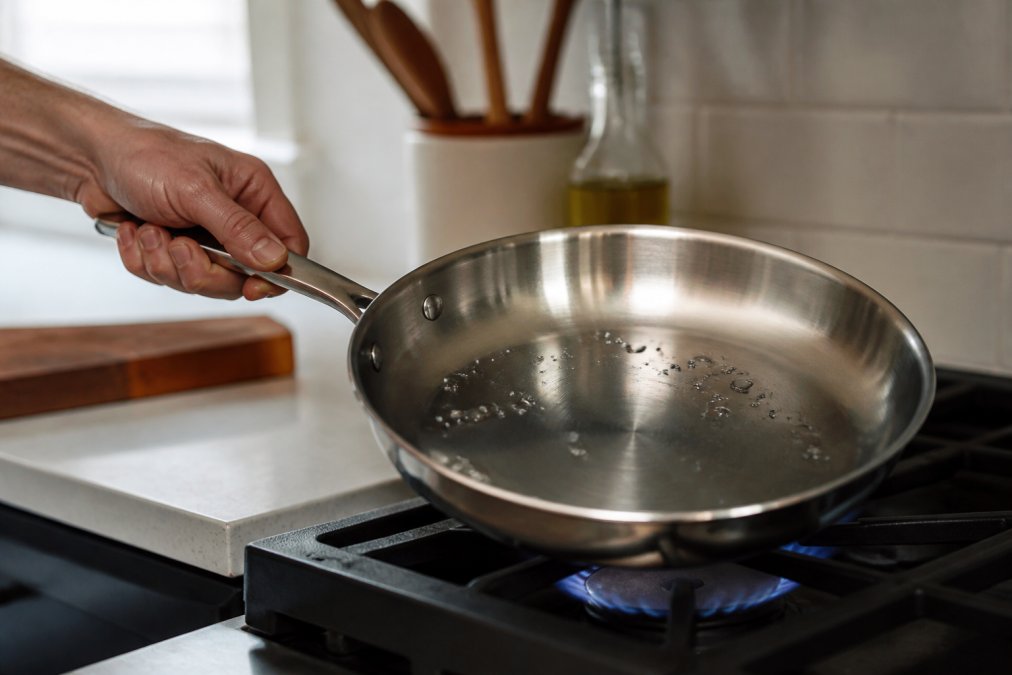
Heat the dry pan over medium heat for two to three minutes, then flick a few drops of water onto the surface. If they sit and sizzle, it is not ready. If they bead up and dance across the pan like mercury, the surface is at the right temperature. Add your oil at that point, then your food. This is called the Leidenfrost effect, and it is the single most useful technique for anyone learning stainless steel.
Deglazing, Fond and Building Flavour
Those browned bits stuck to the pan after searing meat are called fond, and they are flavour, not a cleaning problem. Pour a splash of stock, wine or water into the hot pan and scrape with a wooden spoon. The liquid lifts the fond and becomes an instant pan sauce. Deglazing is the technique that turns stainless steel from a chore into an advantage over non-stick, which cannot build fond at all.
Removing Rainbow Stains from Stainless Steel Pans (and Other Maintenance)
Removing rainbow stains from stainless steel pans takes about two minutes with white vinegar or a lemon wedge. Those iridescent marks are not damage; they are a thin oxide film left by high heat or mineral-rich water, and they wipe away easily.
Warm a little vinegar in the pan, rub with a soft cloth, then wash and dry. For stubborn marks, a paste of bicarbonate of soda and water works without scratching the surface. Avoid steel wool on polished finishes.
Dishwasher-Safe? Yes, With One Caveat
Most uncoated stainless steel is dishwasher safe, which is a genuine time-saver for busy families. The caveat is detergent. Harsh powders and long, hot cycles can dull the finish over time, and stainless left sitting wet in a dishwasher may spot. Rinse and dry promptly and your pans will look new for years.
Safety, Sustainability and the Low-Tox Case for Stainless Steel
Stainless steel is one of the few cookware materials with no coating to degrade, which is why it appeals to families trying to reduce chemical exposure in the kitchen. But the case is stronger than most guides admit, and it extends past the kitchen bench to the end of the pan's life.
No PFAS, No Leaching: What the Science Says
Non-stick coatings have historically relied on PFAS chemicals, a group linked to health concerns and now subject to restrictions in many markets. The Australian Government PFAS information explains how these substances persist in the environment and why regulators are phasing them out. Uncoated stainless steel has no coating to flake, scratch or leach, which removes the question entirely. Food-grade 18/8 stainless is considered stable for cooking acidic foods, and nickel-free 18/0 options exist for anyone with a nickel sensitivity.
For a deeper look at food-contact safety, the Food Standards Australia New Zealand guidance covers how cookware materials are assessed.
The Chemical-Free Cooking Angle Most Guides Skip
The PFAS conversation usually stops at "non-stick is bad." The more useful framing is what you avoid by switching. A coated pan that has been scratched, overheated or run through a hot dishwasher cycle can shed flakes into food, and once the coating is compromised, there is no way to restore it. Stainless steel has no coating layer to fail. The cooking surface is the pan. That is the entire low-tox argument in one sentence, and it is why stainless steel is the default recommendation for anyone replacing scratched non-stick.
Repair, Restoration and Keeping Pans Out of Landfill
Scratched stainless steel can be restored. A little abrasive cleaner and a soft cloth bring back a brushed finish, and riveted handles can often be tightened. Heat tint, the rainbow discolouration from high heat, is a surface oxide film, not damage, and lifts with a vinegar or lemon rub. Pitting from prolonged salt contact is rarer and usually cosmetic. Most coated pans cannot be repaired once the surface is compromised, so they end up in landfill.
The Sustainability Case Beyond the Kitchen
Steel is one of the most recycled materials on the planet, and stainless steel scrap retains its value because the alloy can be re-melted without losing its corrosion resistance. That means a stainless pan at the end of its life, decades from purchase, is a recyclable asset rather than a landfill item. A non-stick pan, by contrast, is a composite of coating, substrate and handle that is difficult to separate and rarely recycled. Over a household's lifetime, the material footprint difference is significant.
We stock the Stainless Steel Oven Tray 18/8 for everyday roasting and baking, and a nickel-free 18/0 version for anyone avoiding nickel. For smaller ovens and caravan kitchens, the Small Oven Tray is the practical size. Crispy-base fans should look at the pizza pan with holes.


Frequently Asked Questions
What's the downside of stainless steel cookware?
The main downsides are weight and a short learning curve. Stainless steel pans are heavier than non-stick or aluminium, which can matter if you have wrist or shoulder issues. Food also sticks more easily until you learn temperature control, so eggs and delicate fish need a little practice. Finally, the upfront cost is higher than budget non-stick, though a good pan can last decades, which brings the cost-per-use down over time.
How long does high-quality stainless steel cookware typically last?
A well-made stainless steel pan with a heavy-gauge base and riveted handles can last 20 to 30 years or more with basic care. The metal itself does not degrade, so the main wear points are loose rivets or a warped base from extreme temperature changes. Because the surface does not flake or scratch like non-stick coatings, there is no need to replace it every few years.
Is tri-ply stainless steel worth it compared to a single-layer pan?
Yes, if you want even heat and less sticking. A tri-ply pan bonds a stainless steel exterior, an aluminium core and a stainless steel cooking surface. The aluminium core spreads heat quickly and evenly, while the stainless steel layers make the pan induction compatible and non-reactive. A single-layer stainless steel pan heats unevenly and develops hot spots, which makes searing and deglazing much harder to control.
How do I remove rainbow stains from stainless steel pans?
Rainbow stains are a thin oxide layer caused by high heat or mineral deposits. They are harmless and easy to remove. Mix one part white vinegar with three parts water, bring it to a simmer in the pan for a few minutes, then wash with warm soapy water and a soft sponge. For stubborn marks, make a paste of bicarbonate of soda and water, rub gently, rinse and dry. Avoid steel wool, which can scratch the surface.
The real challenge is not deciding whether stainless steel is worth it; it is finding pieces built well enough to justify the price. At The Low Tox Project, we stock uncoated stainless steel bakeware that is durable, dishwasher safe and free of flaking coatings, designed for everyday cooking rather than special occasions. Shop the range and make the swap once, not every 18 months.