
Table of Contents
- Why Buy High Quality Stainless Steel Cookware in 2026
- 18/10 Stainless Steel Cookware Benefits Explained
- Stainless Steel vs Non-Stick Cookware Health
- Best Uncoated Stainless Steel Bakeware 2026
- How to Clean Stainless Steel Pans and Keep Them Looking New
- What to Check Before You Buy High Quality Stainless Steel Cookware
- Conclusion
- Frequently Asked Questions
Last Updated: September 11, 2026
Why Buy High Quality Stainless Steel Cookware in 2026
Buy high quality stainless steel cookware once and you may never replace it, which is why so many families are moving away from coated pans that scratch, flake, and shed within a couple of years. This guide from The Low Tox Project breaks down what makes stainless steel worth the investment, how the grades differ, and which pieces earn their place in a low-tox kitchen.

Non-stick is convenient, but convenience has a shelf life. Stainless steel is heavier, needs a little technique, and costs more upfront, in exchange, it doesn't wear out, doesn't leach, and goes straight into the dishwasher.
Below, we'll show you exactly how to choose pieces that last decades rather than seasons, starting with the numbers stamped on the base.
18/10 Stainless Steel Cookware Benefits Explained
18/10 stainless steel cookware is prized because the higher nickel content resists corrosion and holds a mirror finish over years of use, durability that matters more than any marketing claim.
The real benefit is what stainless steel doesn't do: no coating to flake into your food, no reactive surface altering acidic sauces, and no plastic handle degrading in the dishwasher.
18/8, 18/0 and 18/10: What the Numbers Mean
The numbers describe chromium and nickel content. 18/10 stainless steel contains roughly 18% chromium and 10% nickel; 18/8 has 8% nickel; 18/0 has none (bssa.org.uk).
Chromium provides corrosion resistance. Nickel adds toughness and shine. An 18/0 pan, like the Stainless Steel Oven Tray 18/0 - Nickel Free ($47.00), suits anyone with a nickel sensitivity, while 18/8 and 18/10 handle the heaviest daily use.

| Grade | Chromium | Nickel | Best For |
|---|---|---|---|
| 18/10 | 18% | 10% | Saucepans, daily cooking |
| 18/8 | 18% | 8% | Oven trays, bakeware |
| 18/0 | 18% | 0% | Nickel-sensitive households |
Cladding and Cores: Aluminium vs Copper
Stainless steel heats unevenly on its own, so manufacturers bond layers of it around a core of aluminium or copper, cladding. Aluminium spreads heat quickly and cheaply; copper responds faster and more precisely but costs far more. Tri-ply or five-ply construction sandwiches that core so you get even heating without a reactive metal touching your food.
How to read a ply count. A "ply" is one bonded layer. A three-ply pan is typically stainless-steel / aluminium / stainless-steel: the outer skins resist corrosion and take an induction base, while the aluminium core does the thermal work. A five-ply pan adds two more layers, often a second conductive metal (copper or a harder aluminium alloy) plus an extra stainless skin. More plies is not automatically better, a well-bonded three-ply with a thick core usually outperforms a thin five-ply. What matters is the thickness of the conductive core, not the marketing number on the box.
Aluminium vs copper in practice. Aluminium conducts heat at roughly half the rate of copper but costs a fraction as much, which is why it dominates mid-range cookware (engineeringtoolbox.com). Copper gives the most responsive temperature control, useful for sauces and reductions, but is heavier, pricier, and can react with acidic foods if the stainless lining is breached. Most home cooks get 90% of the benefit from a good aluminium-core pan.
Induction compatibility. An induction cooktop needs a magnetic base. Aluminium and copper are non-magnetic, so an induction-ready pan must have a magnetic stainless-steel outer layer (or a bonded magnetic disc) on the underside. Check with a fridge magnet before you buy, if it doesn't stick to the base, it won't work on induction.
Why this matters for bakeware. Most bakeware, including oven trays, is a single sheet of stainless steel rather than tri-ply, so a slight flex as it heats is normal. It relaxes back as it cools. If a tray bends dramatically, that's a manufacturing fault worth raising with the seller.
Why 18/10 Is the Sweet Spot for Cookware
18/10 is the standard for cookware bodies because 10% nickel gives the steel enough toughness to resist denting and enough corrosion resistance to survive decades of acidic cooking, tomato passata, wine reductions, citrus dressings. 18/0 is harder and more magnetic (useful for induction bases and bakeware) but less corrosion-resistant, and 18/8 sits between the two. For a pan you plan to hand down, look for 18/10.
Stainless Steel vs Non-Stick Cookware Health
Stainless steel is the safer long-term choice because it has no synthetic coating to scratch, flake, or degrade into your food. Non-stick coatings wear down with high heat and metal utensils, scratched pans are exactly what push most families to switch.
The concern many parents raise is PFAS, the group of synthetic chemicals historically used in non-stick coatings. Regulatory attention on these substances has increased steadily, and the Australian Government PFAS information outlines how these chemicals persist in the environment and the body.
That doesn't mean every coated pan is dangerous today. It means the surface has a lifespan, and once it's compromised, you're cooking on a degraded layer. Uncoated stainless steel has no layer to lose.
Best Uncoated Stainless Steel Bakeware 2026
The best uncoated stainless steel bakeware in 2026 is food-grade, dishwasher safe, and free from coatings that flake. The Low Tox Project's range covers roasting, baking, and everyday cooking with no plastic lining in sight.
Oven Trays for Roasting and Everyday Cooking
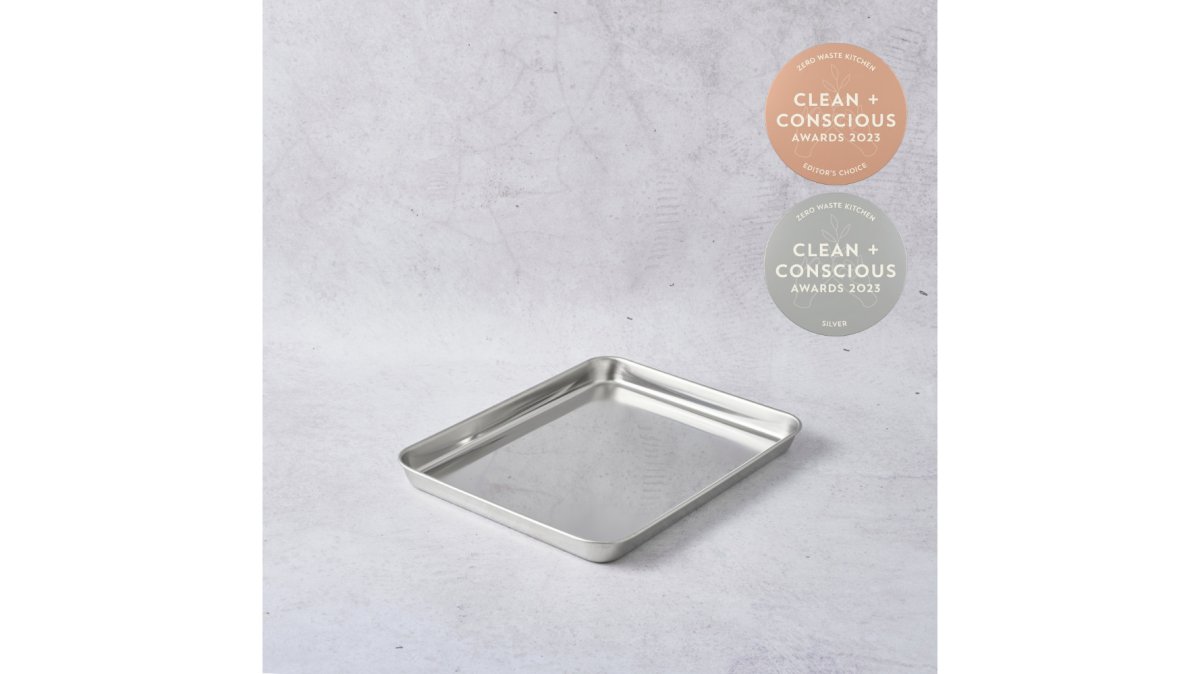
Start with a tray you'll reach for daily. The Stainless Steel Oven Tray 18/8 ($47.00) handles roasting, baking, and no-baking-paper cooking, then goes straight into the dishwasher. If you're cooking for one or working with a compact oven, the Stainless Steel Small Oven Tray ($41.00) and Stainless Steel Mini Oven Tray ($33.00) fit toaster ovens, air fryers, and caravan kitchens.

Pizza Pans, Brownie Pans and Loaf Tins
For crisp bases, the Stainless Steel Pizza Pan with Holes ($45.00) lets moisture escape so the base browns evenly. Prefer deep-dish or gooey toppings? The solid Stainless Steel Pizza Pan ($41.00) keeps the mess contained.
Sweet and savoury bakers have options too: the Stainless Steel Brownie Pan ($41.00), Stainless Steel Loaf Pan ($39.00), Stainless Steel Pie Pan ($35.00), and the Stainless Steel Pullman Bread Pan with Lid ($120.00) for uniform sandwich loaves.
| Piece | Price | Best For |
|---|---|---|
| Oven Tray 18/8 | $47.00 | Roasting, everyday baking |
| Oven Tray 18/0 | $47.00 | Nickel-sensitive households |
| Small Oven Tray | $41.00 | Small ovens, couples |
| Mini Oven Tray | $33.00 | Toaster ovens, caravans |
| Pizza Pan with Holes | $45.00 | Crispy thin bases |
| Pizza Pan (solid) | $41.00 | Deep-dish, saucy toppings |
| Brownie Pan | $41.00 | Slices, small savoury bakes |
| Loaf Pan | $39.00 | Bread, banana loaves |
| Pie Pan | $35.00 | Pies, quiches |
| Pullman Pan with Lid | $120.00 | Uniform sandwich loaves |
How to Clean Stainless Steel Pans and Keep Them Looking New
Cleaning stainless steel pans is simpler than most people expect: wash with hot water, dish soap, and a soft sponge, then dry immediately to avoid water spots. All The Low Tox Project pieces are dishwasher safe, so busy households can skip hand-washing entirely.
For stubborn residue, simmer a little water and vinegar in the pan, then wipe. Avoid steel wool, which scratches the surface and dulls the finish. A paste of bicarbonate of soda lifts burnt patches without abrasive damage.
Removing Heat Tint and Rainbow Discolouration
That blue, gold, or rainbow sheen after high-heat cooking is not damage and not rust. It's a thin oxide film that forms when chromium reacts with oxygen at high temperature, the same passive layer that makes stainless steel corrosion-resistant, just thicker than usual. Here's how to remove it without harming the pan.
Vinegar soak. Mix one part white vinegar to three parts water in the pan, bring it to a gentle simmer for five to ten minutes, then let it cool. The mild acid dissolves the oxide film. Wash and dry as normal. This handles light rainbow tint in a single pass.
Bicarbonate of soda paste. For heavier blue-gold discolouration, apply a paste of bicarb and water, let it sit 15-20 minutes, then scrub gently with a non-scratch pad. Bicarb is mildly abrasive and lifts the oxide without cutting into the steel.
Bar Keepers Friend or a similar oxalic-acid cleaner. For a full restore on a pan with years of accumulated tint, an oxalic-acid cleaner is the most effective option. Apply a little with a damp cloth, rub with the brushed grain, rinse thoroughly, and dry. Use it sparingly, frequent use will slowly dull a mirror finish.
What not to do. Never use steel wool, wire brushes, or chlorine bleach on stainless steel. Steel wool leaves microscopic iron particles embedded in the surface, which rust and create the corrosion spots you were trying to avoid. Bleach can pit the steel, especially if left to sit.
Restoring a Mirror Finish
A brushed or mirror finish dulls over years of use, mostly from mineral deposits and abrasive cleaners. To bring it back:
- For brushed finishes: rub in the direction of the grain with a non-scratch pad and a little bicarbonate of soda or a dedicated stainless polish. Always work with the grain, never across it, or you will leave visible scratch marks.
- For mirror finishes: a small amount of a fine stainless polish on a soft cloth, worked in circles, then buffed off with a clean dry cloth. Do not use abrasive pads on mirror finishes.
- For hard-water spots: a 50/50 vinegar-and-water wipe, left for a minute, then rinsed and dried, removes most mineral film without polishing.
Preventing Discolouration in the First Place
Most heat tint comes from overheating an empty pan or running maximum heat when medium would do. Let the pan come to temperature gradually, add oil once it's hot, and you'll get a non-stick effect without any coating, and far less oxide build-up. Dry pans immediately after washing, since standing water leaves mineral spots that bake into the surface next time you cook.
When to Replace vs Repair
Stainless steel rarely needs replacing. Loose rivets can be tightened or the handle re-riveted by a small kitchen-repair service. A warped base on a tri-ply pan is usually terminal, because the bonded layers have separated, but a single-sheet oven tray that flexes and returns is fine. Buying individual, replaceable pieces rather than sealed sets is the biggest factor in keeping a kitchen going for decades rather than replacing everything when one lid goes missing.
What to Check Before You Buy High Quality Stainless Steel Cookware
Before you buy high quality stainless steel cookware, check four things: the grade, the construction, dishwasher safety, and whether replacement parts or individual pieces are available. Skipping these checks is how people end up with pans that warp or handles that loosen within a year.
- Grade: 18/10 for saucepans, 18/8 or 18/0 for bakeware
- Construction: tri-ply or five-ply for even heating; single-sheet trays are fine for oven use
- Induction compatibility: check the base if you cook on induction
- Handles: riveted, ergonomic, and oven-safe
- Repairability: can you buy the piece alone, or replace a lid?
That last point is the one most buyers ignore. A set with a proprietary lid you can't replace becomes useless the moment one part fails. Buying individual, replaceable pieces, as The Low Tox Project structures its range, keeps a kitchen going for decades rather than forcing a full replacement.
If you're coming from non-stick, expect a short adjustment period. Stainless steel rewards preheating and a splash of oil, and once you've built that habit, food releases cleanly.
Conclusion
The challenge isn't finding stainless steel; it's finding pieces built to last without coatings that quietly break down. The Low Tox Project offers uncoated stainless steel bakeware and cookware that's durable, dishwasher safe, and designed for everyday cooking, with no flaking and no plastic. Shop All Products and replace the scratched non-stick for good.
Frequently Asked Questions
Where can I buy good quality stainless steel cookware?
Specialty kitchenware retailers that specialise in uncoated, food-grade stainless steel are your best bet. Look for pieces made from 18/8 or 18/10 steel, or nickel-free 18/0 if you have sensitivities. The Low Tox Project stocks oven trays, pizza pans, brownie pans, loaf pans and pie dishes from $33 to $120, all dishwasher safe and built for everyday cooking.
What is the best grade of stainless steel cookware?
18/10 is the top grade for cookware, offering the best corrosion resistance and a durable, non-reactive surface. 18/8 is very close in performance and common in bakeware. If you have a nickel sensitivity, 18/0 is a practical alternative because it contains no added nickel. All three are food-safe and free from the coatings that flake off non-stick pans.
Is 18/10 stainless steel the best for cookware?
For most cooking, yes. The 10% nickel content in 18/10 makes it more resistant to corrosion and staining than 18/0, and it holds up well to daily use. That said, 18/8 performs almost identically in practice, and 18/0 is the better pick for anyone avoiding nickel. The grade matters less than the construction: a heavy-gauge pan with an aluminium or copper core will heat more evenly than a thin one.
How do I know if stainless steel cookware is high quality?
Check the grade stamp (18/10, 18/8 or 18/0), the weight and the base construction. A high quality pan feels substantial, has a flat, impact-bonded base that sits evenly on your stovetop, and is oven-safe without plastic handles. Riveted handles and a tempered glass lid are good signs. If a pan is very light and thin, it will likely warp and develop hot spots over time.
How do I stop food sticking to stainless steel pans?
Preheat the pan for one to two minutes before adding oil, then wait for the oil to shimmer before adding food. Let meat and proteins sit undisturbed until they release naturally from the surface. This simple technique, combined with a heavy-gauge pan that distributes heat evenly, makes stainless steel just as practical as non-stick for everyday cooking.