
Table of Contents
- What Are PFAS and Why They Matter in Your Kitchen
- Is Stainless Steel Cookware PFAS-Free? The Short Answer
- Stainless Steel vs Non-Stick Safety: What the Materials Actually Do
- How to Season Stainless Steel for Non-Stick Performance
- Removing Rainbow Stains from Stainless Steel Pans
- Choosing PFAS-Free Cookware: What to Look For
- Frequently Asked Questions
Last Updated: September 10, 2026
What Are PFAS and Why They Matter in Your Kitchen
PFAS, or per- and polyfluoroalkyl substances, are a group of synthetic chemicals used to make products resistant to heat, water, and grease. They have earned the nickname "forever chemicals" because they do not break down easily in the body or the environment. This persistence has made them a global talking point, and it is why so many people are now asking whether their everyday cookware is safe. This guide from The Low Tox Project breaks down exactly where PFAS shows up in the kitchen and how to choose cookware you can feel good about.
The concern is not just theoretical. Authorities including the Australian Government PFAS information have been reviewing these substances for years because of their potential to accumulate in the human body. For families cooking three meals a day, the question of what your pans are made from is a reasonable one to ask.
The Difference Between PTFE, PFOA, and PFAS
These three terms get used interchangeably, and that confusion is exactly what makes shopping for safe cookware so frustrating.
- PFAS is the umbrella term for the entire chemical family, thousands of substances strong.
- PTFE (polytetrafluoroethylene) is one specific PFAS used to create the slick surface on most non-stick pans.
- PFOA was a processing aid historically used to manufacture PTFE. It has been phased out of production in many markets, but "PFOA-free" labels do not mean a pan is PFAS-free.
Is Stainless Steel Cookware PFAS-Free? The Short Answer
Yes. Stainless steel cookware is PFAS-free because it contains no synthetic polymer coating at all. It is made from an alloy of iron, chromium, and often nickel, with no chemical layer applied to the cooking surface. There is no coating to flake, scratch, or degrade into your food.

That is the core reason stainless steel has become a default choice for anyone moving away from non-stick. The material itself is inert and bare metal, meaning nothing is added to it that could leach into a meal.
Why Stainless Steel Is Naturally Free from Non-Stick Coatings
Stainless steel does not need a coating to function. Its cooking surface is the metal itself, polished smooth. Where a non-stick pan relies on a sprayed-on layer of PTFE to stop food sticking, stainless steel relies on heat control and technique. This is a meaningful difference for anyone worried about surface integrity over time.
Stainless Steel vs Non-Stick Safety: What the Materials Actually Do
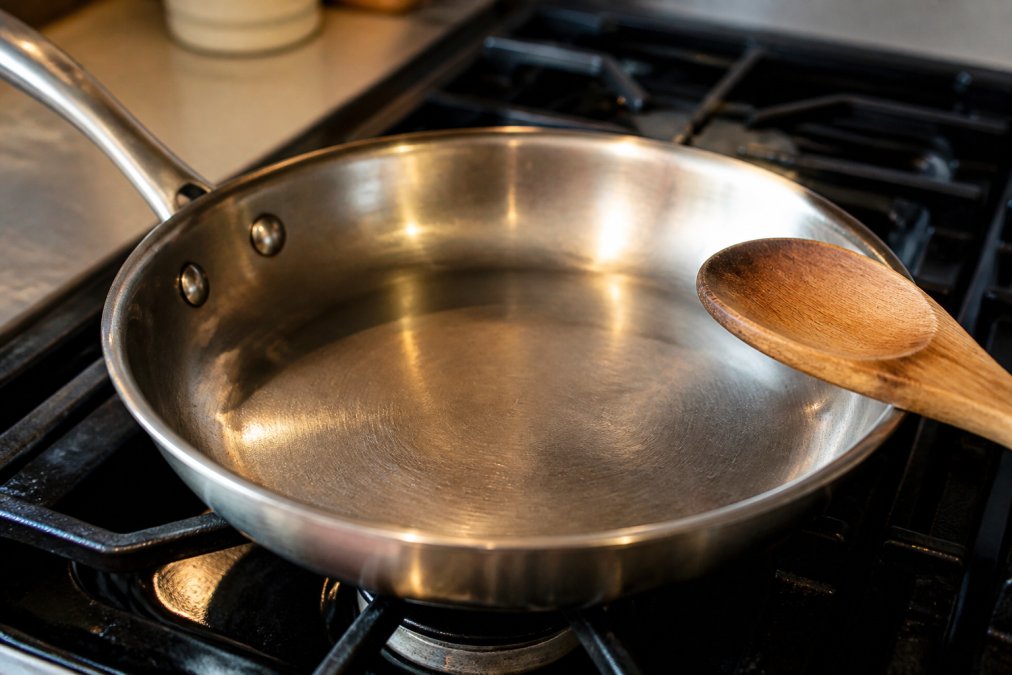
The stainless steel vs non-stick safety comparison comes down to what happens at high heat. Non-stick coatings can degrade when overheated, and a scratched surface exposes more of the coating to the food. Stainless steel has high-heat tolerance and no coating to break down.
That said, stainless steel is not the only safe option. Cast iron, carbon steel, and enamelled cookware are also coating-free or use a glass-based finish. The right pick depends on how you cook and what you are willing to maintain.
| Material | Coating | Best For | Maintenance |
|---|---|---|---|
| Stainless steel | None | Everyday searing, sauces | Easy, dishwasher safe |
| Non-stick (PTFE) | PFAS-based | Low-fat eggs, delicate fish | Delicate, avoid high heat |
| Cast iron | Seasoning layer | Steak, high-heat searing | Regular re-seasoning |
| Carbon steel | Seasoning layer | Wok cooking, fast sears | Regular re-seasoning |
Coated Surfaces, Bare Metal, and the Risk of Flaking
A coated surface will eventually wear. Spatulas, stacking, and dishwasher cycles all take a toll, and once the coating flakes, you are cooking on a compromised surface. Bare metal has no such failure point. This is why durability and surface integrity matter so much when you are choosing cookware meant to last.
How to Season Stainless Steel for Non-Stick Performance
You do not season stainless steel the way you season cast iron. There is no oil layer baked into the metal and no polymerised surface to build up over time. Instead, you create a temporary release layer each time you cook, using heat control and a thin film of fat. This is the technique professional kitchens rely on, and it is the single biggest reason people give up on stainless steel too early.
The mechanism is straightforward. When the pan reaches the right temperature, the metal surface expands microscopically and the oil you add forms an even, near-invisible layer. Food placed onto that layer sears and releases on its own rather than bonding to the metal. Cook on a pan that is too cool and food welds itself to the surface. Cook on one that is too hot and the oil breaks down before the food goes in.
The water-bead test
The most reliable way to know your pan is ready is the water-bead test, sometimes called the Leidenfrost effect. Heat the dry pan over medium heat for two to three minutes, then flick a few drops of water into it.
- If the water hisses and evaporates immediately, the pan is not hot enough yet.
- If the droplets bead up and skitter across the surface like mercury, the pan is at the right temperature.
- If the water vanishes on contact with a sharp sizzle and the pan smells hot, pull it off the heat and let it cool for a minute before continuing.
Once the droplets dance, add your oil, swirl it to coat the base, and let it shimmer for a few seconds before adding food.
Heat management by food type
Different foods need different pan temperatures, and getting this right matters more than any gadget.
- Eggs and fish: medium-low. Add oil, then food, and leave it completely undisturbed until the protein releases on its own. Poking at it early is what causes tearing.
- Chicken breast and thicker cuts of meat: medium. Pat the food dry, place it presentation-side down, and do not move it for the first two to three minutes. It will release when a crust has formed.
- Steak and high-heat searing: medium-high to high, with an oil that has a high smoke point. Expect some smoke; that is normal.
- Sauces and deglazing: after searing, lower the heat before adding liquid. Sudden temperature drops are what cause sticking and burnt patches.
The five mistakes that make food stick
Most sticking complaints trace back to one of these:
- Adding food to a cold pan. The metal has not expanded, so there is no release layer.
- Wet food. Surface moisture steams instead of sears and bonds to the metal. Pat everything dry with a tea towel or paper towel first.
- Too little fat. Stainless steel is not non-stick; it needs a thin, even film of oil or butter.
- Moving food too soon. Give it time to form a crust. If it resists when you slide a spatula under it, it is not ready.
- Overcrowding. Too much food drops the pan temperature and traps steam.
The learning curve is real, but it is short. Most people adjust within a week of daily cooking, and the payoff is a pan that will outlast every coated one in the cupboard.
Removing Rainbow Stains from Stainless Steel Pans
Those iridescent rainbow marks are not damage. They are a thin oxide film caused by overheating or mineral residue, and removing rainbow stains from stainless steel pans is straightforward. A paste of bicarbonate of soda and water, applied with a soft cloth and a little elbow grease, lifts them in most cases.
For tougher marks, a splash of white vinegar followed by a gentle scrub works well. Avoid steel wool, which scratches the surface and makes future staining more likely.
Choosing PFAS-Free Cookware: What to Look For
When you are shopping for PFAS-free cookware, look for uncoated materials and clear material disclosure. Brands that list their exact alloy grade, such as 18/8 or 18/10 stainless steel, are telling you there is no mystery coating in the mix.
Grades, Testing, and the Leaching Question
A fair question is whether low-quality stainless steel can leach heavy metals. The concern is real for poorly made, unverified alloys, particularly under acidic cooking. The fix is to buy food-grade stainless steel from a supplier that can tell you what is in it. This is where third-party testing verification matters. Look for brands that can point to independent testing rather than making vague "non-toxic" claims.
At The Low Tox Project, our stainless steel oven trays are made from uncoated 18/8 food-grade steel, with no flaking and no plastic. We also offer a nickel-free 18/0 option for anyone with sensitivities. Both are dishwasher safe and built for everyday cooking.
- Stainless Steel Oven Tray 18/8 - $47.00
- Stainless Steel Oven Tray 18/0 - Nickel Free - $47.00
- Stainless Steel Small Oven Tray - $41.00
- Stainless Steel Pizza Pan with Holes - $45.00
For more on material safety in food contact products, the Food Standards Australia New Zealand guidance is a useful reference. If you want to understand the broader regulatory picture on these chemicals, the Australian Government PFAS overview sets out how authorities are approaching them.


Swapping out a scratched non-stick pan is one of the simplest low-tox changes you can make, and it does not require a whole kitchen overhaul. Start with the pan you use most and build from there. The Low Tox Project makes that switch practical with uncoated stainless steel bakeware that is durable, dishwasher safe, and free from any coating that could flake into your food. Browse the range and find the pieces that fit how your family actually cooks. Shop All Products.
Frequently Asked Questions
Is it unhealthy to cook in stainless steel?
Stainless steel is considered safe for everyday cooking. It contains no PFAS or non-stick coatings, so there is no risk of forever chemicals leaching into food. Trace amounts of nickel and chromium can be released, particularly with acidic foods and lower-grade pans, but these levels are generally well within food safety limits. Choosing 18/10 or 18/8 food-grade stainless steel reduces this risk further.
How can I tell if my cookware has PFAS?
Check the label or product description for terms like PTFE, PFOA, or 'non-stick coating'. If a pan claims to be non-stick and does not explicitly state it is PFAS-free, assume it contains a synthetic polymer coating. Bare metal pans such as stainless steel, cast iron, or carbon steel have no coating to check. If the surface scratches easily and flakes, it is likely coated.
What is the safest cookware for your health?
Uncoated stainless steel, cast iron, and carbon steel are among the safest options because they contain no PFAS or synthetic coatings. Stainless steel is durable, dishwasher-safe, and does not react with most foods. For those with nickel sensitivity, 18/0 stainless steel is a nickel-free alternative. The key is to avoid scratched non-stick pans and replace them with bare metal.
Are there any hidden chemicals in stainless steel pans?
Stainless steel is an alloy of iron, chromium, and often nickel, with no PFAS or plastic coatings. Some lower-quality pans may release small amounts of heavy metals when cooking acidic foods, but food-grade stainless steel is manufactured to meet safety standards. Third-party testing can verify material composition. Choosing reputable brands and avoiding damaged pans reduces any potential exposure.