Table of Contents
- What to Look For in Safe, Non-Toxic Kitchenware
- Single-Walled vs Double-Walled: Which Stainless Steel Cup Do You Need?
- Our Top Picks for Everyday Stainless Steel Cups
- BPA-Free Drinking Cups: What the Labels Really Mean
- How to Clean Stainless Steel Cups Without Damaging Them
- Which Stainless Steel Cup Should You Choose?
- Frequently Asked Questions
Why Stainless Steel Cups Are Replacing Plastic and Glass
A stainless steel cup is a durable, reusable drinking vessel made from food-grade stainless steel that offers a safer alternative to plastic and glass. Plastic cups scratch, harbour bacteria, and can leach compounds over time, while glass shatters easily around kids, on campsites, and in caravan sinks (peer-reviewed research).
At The Low Tox Project, we help families swap out questionable kitchenware for materials that simply do what they are supposed to do. Stainless steel is shatterproof, corrosion-resistant, and free of the coatings that flake off cheaper alternatives.
Food-grade stainless steel is non-toxic, BPA-free, and endlessly reusable, making it a genuinely eco-friendly choice for households trying to cut down on single-use plastics. Below, we walk you through what to look for, which style suits your needs, and how to keep your cups looking new.
What to Look For in Safe, Non-Toxic Kitchenware
The single most important factor when choosing non-toxic kitchenware is the material grade. You want cups made from food-grade stainless steel, often labelled as SUS304 or 304 grade, the industry standard for safe contact with food and drink. This grade is corrosion-resistant and does not react with acidic beverages.

A common mistake is assuming all stainless steel is the same. Some cheaper products use lower grades that are more prone to corrosion or contain trace impurities. Look for clear statements about food-grade material and avoid anything with internal coatings, plastic liners, or painted surfaces that could degrade.
Check for the absence of plastic parts that touch your mouth or the liquid. Many "stainless" cups still ship with plastic lids and straws, which defeats the purpose of switching. Seek out designs with stainless, silicone, or glass components instead.
Understanding Steel Grades: 304 vs 316
Most product pages simply say "stainless steel" without telling you which grade. That omission matters because the grade determines how the cup behaves over its lifetime.
304 grade (18/8 stainless steel) is the most common food-grade alloy. The numbers refer to the composition: approximately 18% chromium and 8% nickel. Chromium creates a passive oxide layer that prevents rust and corrosion, while nickel adds formability and toughness. This grade is safe for water, juice, tea, coffee, and most beverages.
316 grade (18/10 with molybdenum) adds 2-3% molybdenum to the alloy, significantly improving resistance to chloride corrosion, so it handles saltwater, chlorinated water, and highly acidic environments better than 304. For everyday drinkware, 316 offers marginal practical benefit over 304 unless you regularly drink highly acidic concoctions or use the cup in coastal, salty environments. The trade-off is cost: 316 is noticeably more expensive.
What about 201 or 202 grade? These are lower-cost alloys that substitute manganese for some of the nickel. They are less corrosion-resistant and can leach trace amounts of manganese and nickel into acidic beverages, especially when scratched or worn. If a product does not state its grade, treat that as a red flag and choose a brand that is transparent.
Why Grade Matters for Taste and Safety
A lower-grade steel can impart a metallic taste to your drink. This happens when the passive oxide layer breaks down, usually from scratching, abrasive cleaning, or prolonged contact with acidic liquids, allowing iron and other metals to migrate into the beverage. Food-grade 304 and 316 maintain their oxide layer under normal use.
For heavy metal leaching concerns, the science is reassuring. Both 304 and 316 are formulated to resist corrosion precisely so that metal ions stay bound in the alloy rather than migrating into food or drink. The risk of lead or cadmium contamination is minimal when the alloy is properly manufactured.
Practical Checklist for Choosing a Safe Cup
When you are comparing products, run through this checklist:
- Grade stated clearly: Look for "304" or "18/8" or "316" on the product page or packaging. If it just says "stainless steel," ask the seller.
- No internal coatings: The interior should be bare, uncoated steel. Some cups have a ceramic or titanium coating inside, which is fine if it is clearly food-safe, but uncoated steel is the simplest and most reliable option.
- Minimal plastic contact: Check where the lid, straw, or spout touches your mouth. Silicone and stainless are preferable to hard plastic.
- Dishwasher safe: This is a sign the finish is durable enough to handle detergent and heat without degrading.
- Brand transparency: Reputable manufacturers publish their material specifications and safety testing. If that information is missing, move on.
Single-Walled vs Double-Walled: Which Stainless Steel Cup Do You Need?
The choice between single-walled and double-walled stainless steel cups comes down to one question: do you need temperature retention, or is durability and simplicity your priority?

Single-walled cups are lightweight, stackable, and ideal for everyday water, juice, and cold drinks at home, at the picnic table, or in the caravan. They conduct temperature quickly, but they are practically indestructible and take up minimal cupboard space.
Double-walled cups feature two layers of stainless steel with a vacuum or air gap between them. This insulation keeps cold drinks colder for longer and hot drinks warmer, while the outer surface stays condensation-free and comfortable to hold. They are the better pick for smoothies, iced coffee, or hot drinks.
| Cup Type | Best For | Key Benefit | Trade-Off |
|---|---|---|---|
| Single-walled | Everyday water, juice, camping | Lightweight, stackable, low cost | No temperature retention |
| Double-walled | Smoothies, iced drinks, hot drinks | Insulated, condensation-free | Bulkier, higher cost |
For toddlers and young children, double-walled cups are a smart choice because they keep drinks cool without the cup sweating, which means no wet laps and no burning little hands on hot drinks.
Our Top Picks for Everyday Stainless Steel Cups
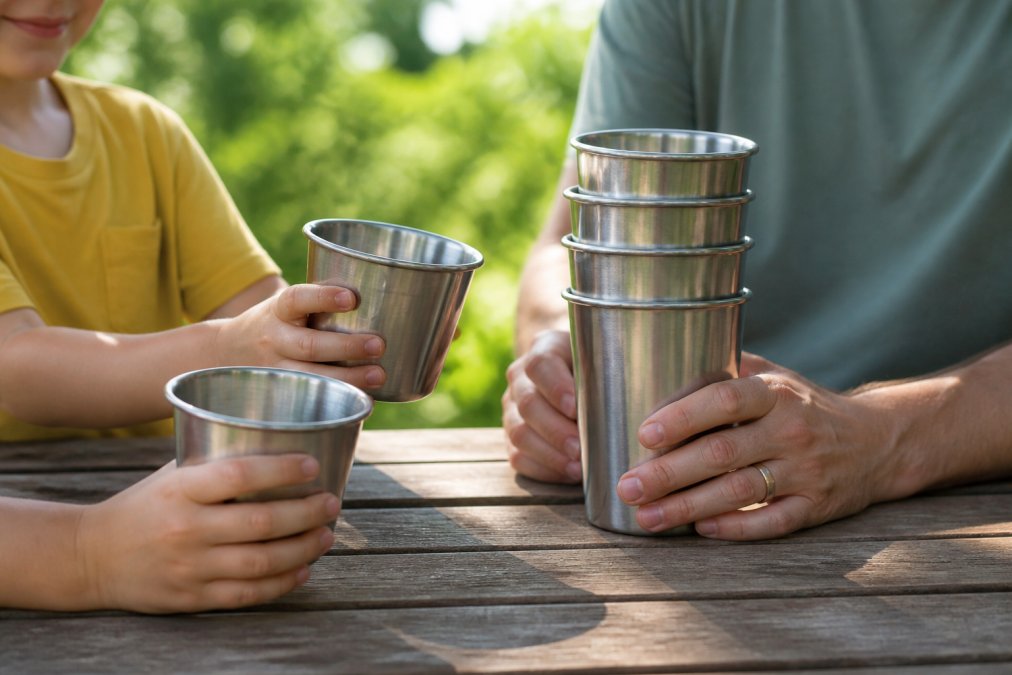
The Low Tox Project range covers the practical bases without overcomplicating things. Every cup is made from uncoated, food-grade stainless steel with no plastic liners, and each is dishwasher safe. Here are the options that suit most households. stainless steel water filtration.
350ml Stainless Steel Drinking Cup: The All-Rounder
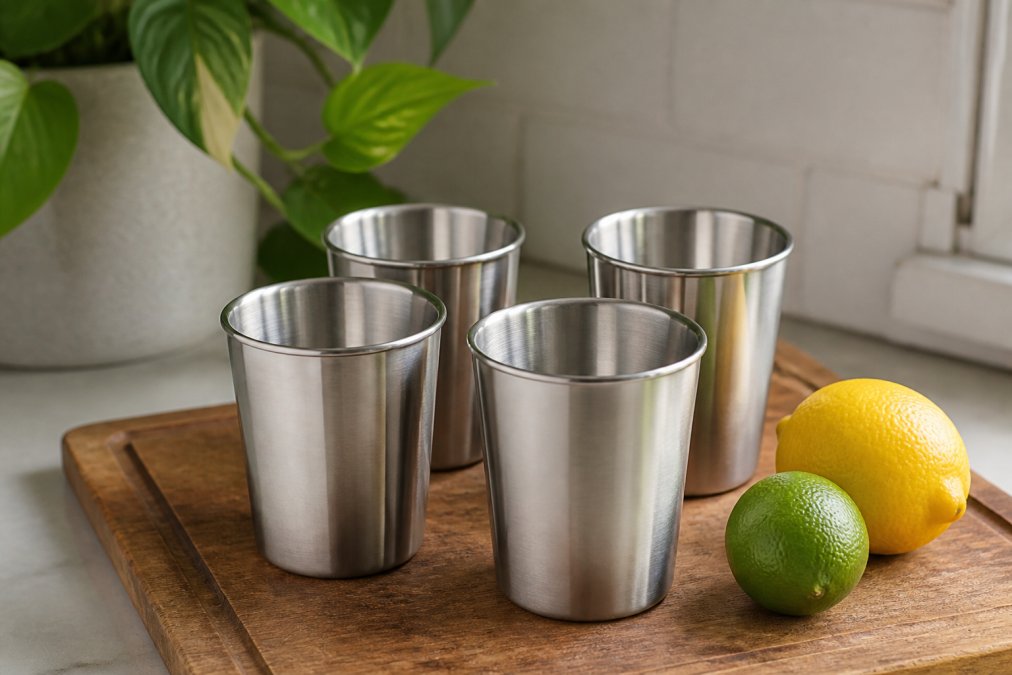
Our 350ml stainless steel drinking cup is the perfect all-rounder for cold drinks, camping, and everyday use. It is lightweight, stackable, and tough enough to survive the kids' table, and at $9.00 it is an easy entry point for upgrading your drinkware. Optional silicone bands fit this size for extra grip and colour-coding.
500ml Stainless Steel Drinking Cup: For Bigger Thirsts
When 350ml is not enough, the 500ml stainless steel drinking cup steps in. Priced at $10.50, it suits water, smoothies, milk, and juice for older kids and adults, and it is equally at home in a lunchbox, on the bench, or packed in the van for a road trip.
Double-Walled Cups for Kids: Sip and Straw Tops
For younger children, the 250ml double-walled cup with sip and straw tops keeps drinks cooler for longer without condensation. At $35.00, it features interchangeable lids that grow with your child. The 350ml double-walled cup with silicone sleeve and straw, at $33.00, is ideal for smoothies and iced drinks.

BPA-Free Drinking Cups: What the Labels Really Mean
BPA-free is a useful starting point, but it is not the whole story. Bisphenol A (BPA) is a chemical used in some plastics that has raised health concerns, and a BPA-free label means the product does not contain that specific compound (the WHO). However, stainless steel cups go further because they contain no plastic in the parts that touch your drink.
When you choose a stainless steel cup, you are not just avoiding BPA. You are avoiding the entire class of concerns around plastic additives, microplastics, and the gradual breakdown that happens as plastic cups get scratched and worn.
That said, not all stainless steel is created equal. Look for cups that state they are made from food-grade 304 stainless steel, and be wary of cheap imports that do not specify their material grade.
How to Clean Stainless Steel Cups Without Damaging Them
Cleaning stainless steel cups is straightforward, and the good news is they are dishwasher safe, so you do not need special techniques or extra effort.
For everyday cleaning, simply pop them in the dishwasher or wash with warm soapy water. Because the surface is non-porous, they will not absorb odours or stains. If you do get a stubborn mark, a paste of bicarbonate of soda and water will lift it without scratching the surface.
Avoid using harsh abrasive scourers or steel wool, which can scratch the finish over time. For double-walled cups, let them air dry thoroughly after washing, and if you use the lids, give those a separate clean. Silicone bands and sleeves can be removed and washed separately.
Deep Cleaning for Lingering Odours
Even though stainless steel is non-porous, you may occasionally notice a residual smell after storing milk, protein shakes, or herbal tea for extended periods. This is usually trapped in the lid gasket or in microscopic scratches rather than the steel itself. Here is a step-by-step deep clean:
- Disassemble everything: Remove the lid, straw, silicone band, and any gaskets. Wash each part separately in warm soapy water.
- Bicarbonate paste for the interior: Mix three parts bicarbonate of soda with one part water to form a paste. Apply it to the interior with a soft cloth or sponge, scrub gently, and rinse thoroughly. This neutralises odours without scratching.
- White vinegar rinse for stubborn smells: Fill the cup with a solution of one part white vinegar to three parts warm water. Let it sit for 15-20 minutes, then rinse thoroughly with fresh water. Do not leave vinegar in longer than 30 minutes, as prolonged acid exposure can dull the finish over years of repeated use.
- Bottle brushes for the bottom: A standard dish sponge cannot reach the bottom corner of a tall cup. Use a flexible bottle brush with soft bristles to scrub the interior base where residue tends to collect.
- Dry upside down: After rinsing, place the cup upside down on a drying rack so water does not pool inside. For double-walled cups, this prevents any moisture from getting trapped around the rim seam.
Sanitising for Illness or Shared Use
If someone in the household has been sick, or if you are using cups for a shared event, you can sanitise stainless steel without harsh chemicals. The simplest method is to pour boiling water into the cup, let it sit for 5 minutes, then pour it out and air dry.
For a more thorough sanitisation, you can use a food-safe sanitiser tablet (the same kind used for home brewing) dissolved in water according to the label instructions. Avoid chlorine bleach, which can pit stainless steel over time (the CDC).
Removing Stains and Water Marks
Hard water can leave white mineral deposits on the exterior of stainless cups. A quick wipe with a cloth dampened with white vinegar dissolves these deposits. For stubborn tea or coffee stains inside the cup, the bicarbonate paste method above works well.
Maintenance Schedule for Longevity
With proper care, a stainless steel cup should last for decades. A simple routine keeps it in top condition:
- Daily: Rinse after use, especially if you have been drinking milk, smoothies, or anything sugary.
- Weekly: Wash in the dishwasher or with warm soapy water, including the lid and any removable parts.
- Monthly: Do a bicarbonate deep clean to prevent any odour build-up.
- As needed: Replace silicone gaskets or bands if they become cracked or stretched, as these can harbour bacteria in the crevices.
By following these steps, your stainless steel cups will stay fresh, odour-free, and looking new for years.
Which Stainless Steel Cup Should You Choose?
If you want one cup that does everything, start with the 350ml stainless steel drinking cup for its versatility, low price, and stackable design. Families with older kids or bigger thirsts should consider the 500ml version, while parents of toddlers will get the most value from the double-walled cups.
A simple way to decide is to match the cup to the drink and the drinker:
- Water and juice at home or camping: single-walled 350ml or 500ml cup
- Smoothies and iced coffee: double-walled 350ml cup with silicone sleeve and straw
- Toddlers and young children: double-walled 250ml cup with sip and straw tops
- Packing light in the caravan: single-walled cups that stack neatly
Stainless steel cups are one of the simplest swaps you can make for a healthier, more sustainable kitchen. They are durable, shatterproof, and free from the plastics and coatings that wear out over time.
Choosing safer drinkware does not have to mean turning meal times into a science project. The Low Tox Project offers a range of uncoated, food-grade stainless steel cups that are dishwasher safe, built to last, and designed for everyday family life. Whether you need a lightweight cup for the caravan or an insulated double-walled cup for little hands, explore the full range and make the switch to drinkware you can trust.
Frequently Asked Questions
Is it healthy to drink out of a stainless steel cup?
Yes. Food-grade stainless steel is non-toxic and does not leach chemicals into your drinks. Unlike plastic, it is free from BPA and other endocrine disruptors. It is also non-porous, so it won't harbour bacteria or absorb odours. This makes stainless steel cups a safe, healthy choice for water, juice, smoothies, and hot drinks for the whole family.
Are stainless steel cups better than glass or plastic?
For everyday use, yes. Stainless steel is shatterproof, making it safer for children and travel than glass. Unlike plastic, it won't leach chemicals and is more durable. Stainless steel cups are also lightweight, stackable, and easy to clean, offering a practical and sustainable alternative that lasts for years.
What is the best way to clean stainless steel cups?
Most stainless steel cups are dishwasher safe. Use warm soapy water and a soft cloth. For stubborn stains or odours, a paste of bicarbonate of soda works well. Avoid harsh abrasives that can scratch the surface. Silicone bands and lids should be removed and washed separately.
What should you not put in a stainless steel cup?
Avoid leaving highly acidic drinks like citrus juice or tomato juice in a stainless steel cup for long periods, as this can affect the taste. Dry table salt should not be left in contact with the steel. For double-walled cups, do not put them in the microwave or freezer, as this can damage the insulation.