Table of Contents
- Why Checking Your Cookware Feels Confusing
- What PFAS Are and Why They Show Up in Cookware
- How to Tell if a Pan Is PTFE-Coated
- Reading Labels: PFOA-Free vs PFAS-Free Cookware
- Questions to Ask Cookware Manufacturers About PFAS
- Can You Test Cookware for PFAS at Home?
- Choosing Your Next Pan: Stainless Steel as a Starting Point
- Frequently Asked Questions
Last Updated: November 18, 2026
Why Checking Your Cookware Feels Confusing
Most of us have a non-stick pan at the back of the cupboard, or one that has been scratched to bits. You might wonder what is actually in the coating, and whether it matters. Learning how to identify PFAS in kitchen cookware can feel like a lot of jargon to work through.
We want to make this easier. This guide walks you through what the label terms mean, and what you can and cannot check yourself.
What PFAS Are and Why They Show Up in Cookware
PFAS, or per- and polyfluoroalkyl substances, are a large family of man-made chemicals. They have been used in some non-stick coatings and water-resistant products for decades. You may also hear them called "forever chemicals" because they break down very slowly in the environment.
PTFE is one well-known member of this family. Many traditional non-stick coatings are made from PTFE, which is sometimes shortened to "Teflon" as a brand name. Knowing this helps when you read product descriptions.
Not every PFAS is used in cookware today, and product formulations change over time. The best approach is to check what each product says about its coating.
How to Tell if a Pan Is PTFE-Coated
Start by looking at the pan itself. A smooth, dark, slippery surface is a common sign of a PTFE-type non-stick coating. Stainless steel usually looks more matte and has a metallic shine that does not peel.
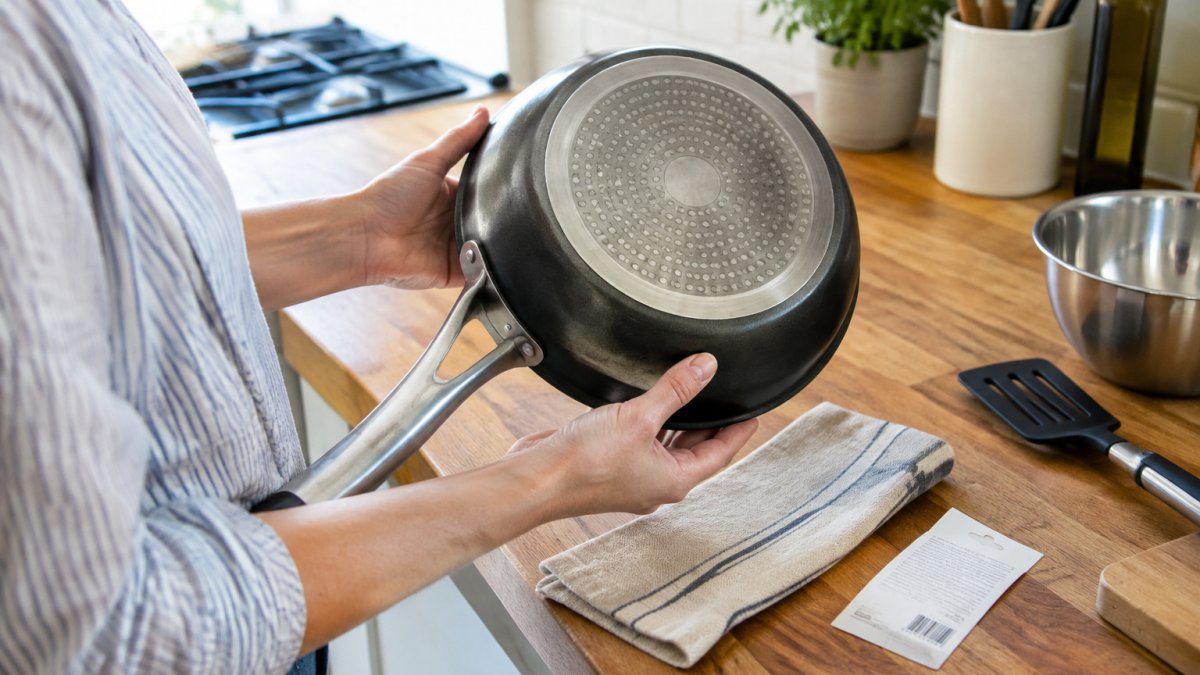
Check the packaging and any care card for words like "non-stick", "PTFE" or "fluoropolymer". Look at the base of the pan too, as the manufacturer name and material details are often printed there.
Here is a quick scan you can do at home:
- Surface feel: Slick, coated surfaces often feel different from bare metal.
- Wear signs: Flaking, bubbling or grey patches can mean the coating is breaking down.
- Labels: Look for the words PTFE, fluoropolymer or non-stick on the box or base.
- Care instructions: Many coated pans ask you to avoid high heat or metal utensils.
Scratched or flaking non-stick pans are worth replacing, and you can read more in our guide to dangers of scratched non-stick pans.
Here is a quick scan you can do at home to get a sense of what your pan is made from.
| What to check | What it can suggest | Note |
|---|---|---|
| Surface feel | Slick coated surface | Compare with bare metal |
| Wear signs | Coating may be breaking down | Flaking, bubbling or grey patches |
| Labels | PTFE, fluoropolymer or non-stick | Check the box or base |
| Care instructions | Coated pans often ask for lower heat | Avoid metal utensils |
Reading Labels: PFOA-Free vs PFAS-Free Cookware
This is where most of us get stuck, because the three claims you see most often sound almost identical but cover very different ground. Once you know what each one is actually saying, the packaging gets a lot easier to read.
PFOA-free refers to one specific compound, perfluorooctanoic acid, which was historically used as a processing aid in making some fluoropolymers. It was phased out of cookware manufacturing in many markets, and a product carrying this claim is telling you that particular substance is not present. It is not telling you the coating is free of all PFAS. A PTFE coating can be PFOA-free and still be a fluoropolymer.
PTFE-free is narrower again. It tells you the product does not use polytetrafluoroethylene, the polymer behind most traditional non-stick surfaces. A pan could be PTFE-free and still use a different fluorinated material, so treat this as one piece of the picture rather than a whole answer.
PFAS-free is the broadest of the three. In principle it covers the entire chemical family, which is a much bigger promise. Because it is broader, it is also the claim that most depends on the manufacturer's evidence. A vague PFAS-free badge with no supporting detail tells you less than a specific statement naming the coating and the testing behind it.
A quick way to keep them straight:
- PFOA-free = one compound excluded.
- PTFE-free = one polymer excluded.
- PFAS-free = the whole family excluded, in principle.
Watch out: a label can be technically accurate and still misleading by omission. "PFOA-free non-stick" on the front of a box often sits above a coating that is still PTFE, and shoppers reasonably read the first claim as covering the second.
How to verify a manufacturer's claim
When a claim matters to you, a short email to the brand usually sorts it out. Ask which specific substances the claim covers, whether it applies to the coating, the base metal or both, and whether they can share documentation or independent test results. Ask too whether the claim covers all fluorinated chemicals or just the one named on the box.
A clear, specific reply is a good sign. A reply that repeats the marketing line without adding detail tells you the claim is doing more work than the evidence behind it. This is the same approach we take when we describe our own stainless steel bakeware: the material is stated plainly, and care instructions come from the manufacturer.
Australian Government guidance on PFAS and the environment
Questions to Ask Cookware Manufacturers About PFAS
If a label leaves you unsure, contact the brand directly. Good questions include:
- Which specific substances are in the coating, if any?
- Can you provide documentation or independent test results?
- Does the claim cover all fluorinated chemicals or just one compound?
- What temperature limits apply to the product?
A clear, specific answer is a good sign. Vague replies deserve a closer look. Our guide to what nickel-free stainless steel cookware labels actually mean explains the terms you may see in those replies.
Can You Test Cookware for PFAS at Home?
Short answer: not in any way that gives you a dependable result. There is no reliable household test that will tell you whether a pan's coating contains PFAS, and kits sold for home use are not a substitute for laboratory analysis. What you can do at home is gather clues, and it helps to be clear about what those clues are worth.
What household checks can and cannot tell you
Looking at a pan, feeling the surface and reading the label can tell you whether a coating is likely to be a fluoropolymer-type non-stick. A smooth, dark, slippery surface that beads water is consistent with a PTFE-style coating, and flaking or bubbling suggests the coating is breaking down. Those observations are useful for deciding whether to keep using a pan.
What they cannot do is confirm or rule out PFAS. Appearance does not identify chemistry, and a ceramic-looking coating can still contain additives you cannot see. Treat every at-home check as a screening clue, not a result.
Screening versus laboratory testing
Laboratory methods work at two broad levels, and the difference matters if you ever need a formal answer.
Total fluorine screening measures the total amount of fluorine in a sample. It is a useful first pass because it flags whether fluorinated compounds are present at all, but it does not tell you which ones, and it can pick up fluorine from sources unrelated to PFAS.
Targeted analysis looks for specific compounds, such as particular PFAS, using reference standards. It is more precise but only finds what it is set up to look for, so a narrow panel can miss substances outside its list.
Neither approach is something you can replicate in a kitchen. If you need a formal result, an accredited laboratory is the only dependable route, and the method used shapes what the result can actually establish.
Food Standards Australia New Zealand guidance on food contact materials
Choosing Your Next Pan: Stainless Steel as a Starting Point
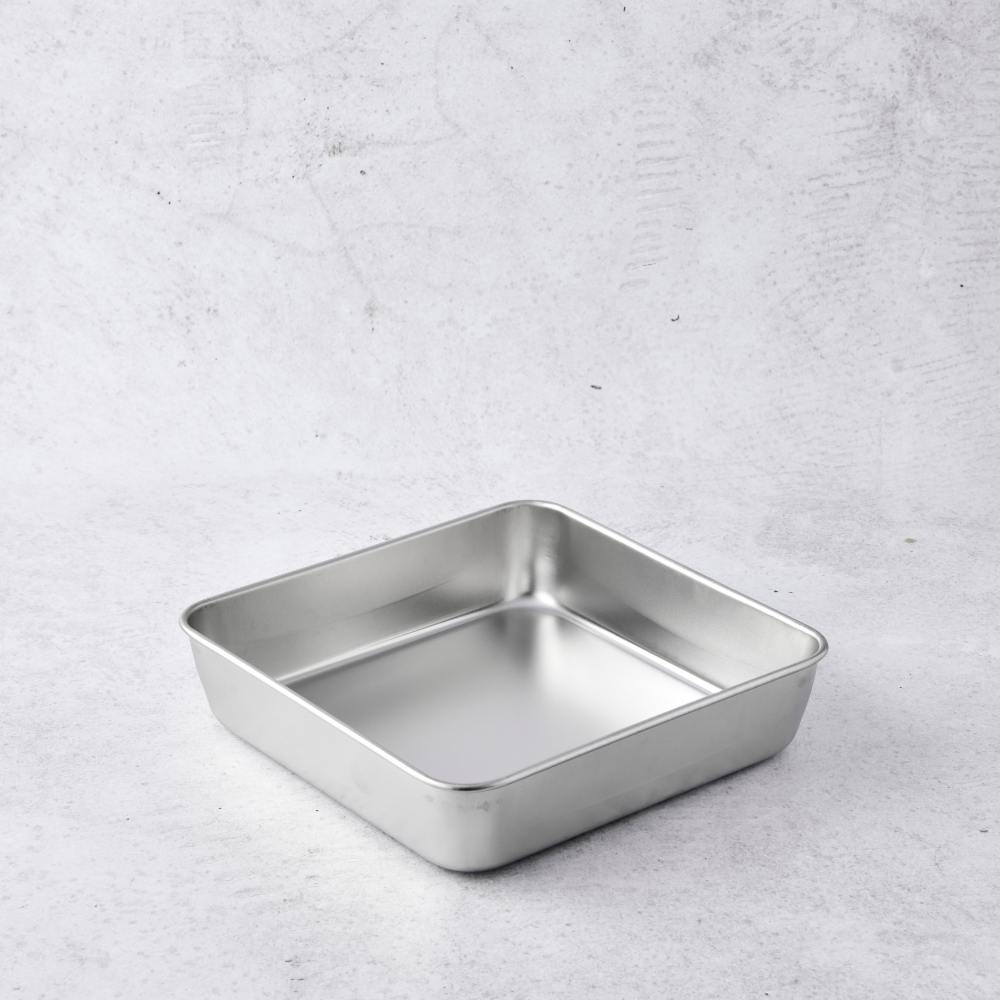
If you are ready to replace a worn non-stick pan, stainless steel is a practical option. It is durable and dishwasher-friendly. At The Low Tox Project, our Stainless Steel Oven Tray 18/8 is made from 18/8 stainless steel.
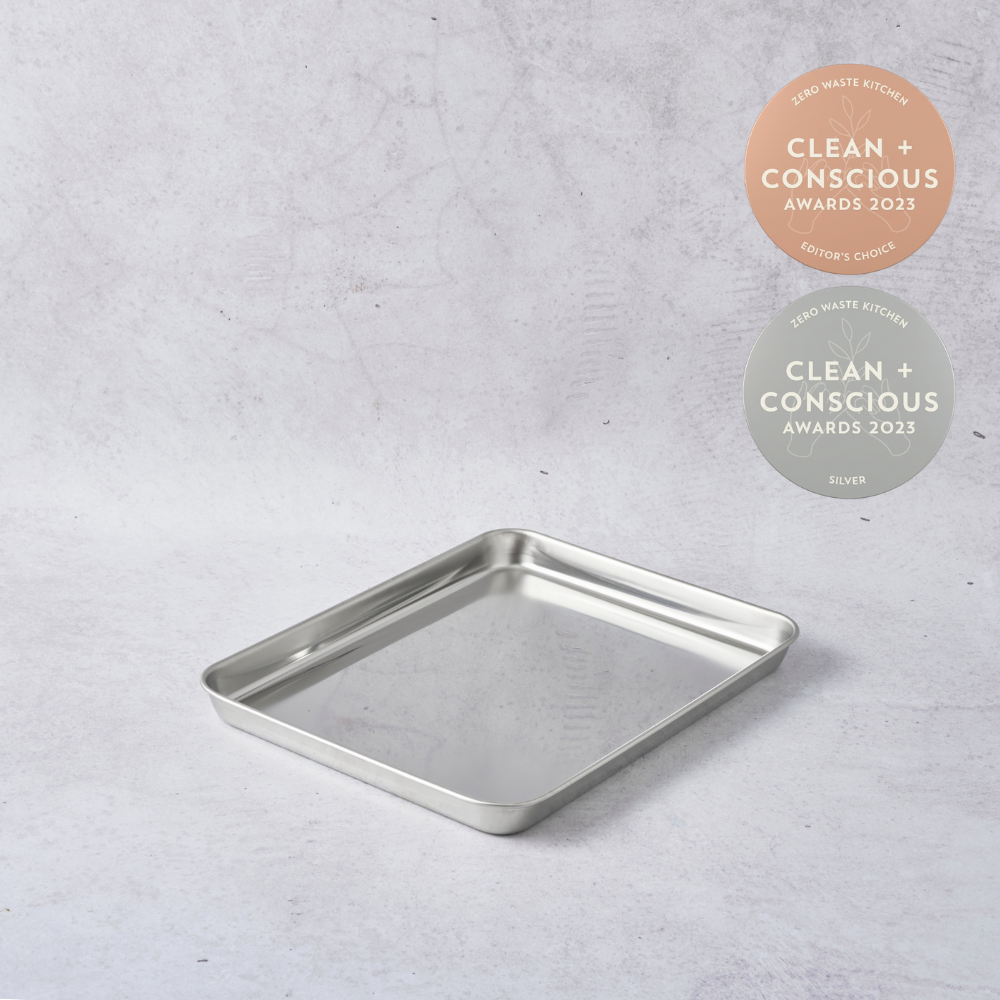
For our stainless steel bakeware, we recommend greasing with a little butter, oil or ghee before use. Seasoning is optional, and your cookware manufacturer's instructions are the best guide for that.
If you want to compare options before you buy, our broader non-toxic cookware guide is a good place to start. You can also explore our stainless steel bakeware guide to see which pieces are worth having in your kitchen.
Frequently Asked Questions
How can I tell if my cookware contains PFAS?
You can't be certain just by looking at a pan, because PFAS are chemicals rather than something you can see or smell. What you can do is check the product listing and packaging for terms such as PTFE, fluoropolymer, non-stick or PFAS-free, then ask the manufacturer directly what the coating is made from. If the brand can't or won't tell you, that's useful information in itself. Keeping an eye on a pan's condition also helps, since heavily scratched or flaking coatings are generally worth replacing regardless of what they are made from.
Does a non-stick label mean a pan contains PFAS?
Not automatically, but it's a good prompt to look closer. Many non-stick coatings are based on PTFE, which belongs to the wider family of fluorinated compounds often grouped under PFAS. Some newer coatings are marketed as PFAS-free, though these may use other chemistry, so the label alone doesn't settle the question. The most practical step is to read the full product description and check what the manufacturer says the coating contains.
Is PTFE a type of PFAS?
PTFE is generally considered a fluoropolymer, and it is often classed within the broader PFAS group, which covers thousands of fluorinated substances. Because the term PFAS is broad, you may see different organisations draw the lines differently. For everyday shopping, it's more useful to know that a PTFE-coated pan is a non-stick pan with a fluorinated coating, and to decide from there whether that suits your household.
Does PFOA-free mean PFAS-free?
No. PFOA is one specific PFAS compound that was phased out of many cookware coatings in earlier years. A pan can be labelled PFOA-free while still containing other fluorinated substances, including PTFE. That's why PFOA-free on its own doesn't tell you the full story. Look for clear information about the whole coating, or ask the manufacturer whether the product contains any PFAS-related chemistry at all.