Table of Contents
- What Happens When You Use a Scratched Non-Stick Pan?
- PFAS in Cookware: Why the Coating Breakdown Matters
- How to Tell if Your Pan Is Unsafe: A Visual Guide
- When to Replace Non-Stick Pans: Your Safety Checklist
- Repair vs. Replace: Can You Fix a Damaged Coating?
- Non-Toxic Cookware Alternatives That Last
- Making the Switch Without the Stress
- Frequently Asked Questions
Last Updated: September 5, 2026
What Happens When You Use a Scratched Non-Stick Pan?
The dangers of scratched non stick pans go far beyond aesthetics, and understanding this starts with what the coating is actually made from. Non-stick coatings are synthetic layers of various polymers, most commonly polytetrafluoroethylene (PTFE), which is a type of per- and polyfluoroalkyl substance (PFAS). When that surface stays intact, it can perform well. Once scratched, the pan's integrity changes in two distinct ways: the coating sheds particles into your food, and the exposed areas become vulnerable to further breakdown.
The most common question we hear is whether a few scratches really matter. The short answer is Yes - a scratched pan is no longer the safe, non-stick tool you originally bought. These scratches create pathways for chemical leaching and provide a foothold for bacteria, turning a once convenient item into a source of kitchen hygiene concern.
The physical process is straightforward. Every time you use a metal utensil, scour the surface with an abrasive pad, or stack pans without protection, you remove a little more of that coating. Those particles don't just disappear; they end up in your meal. While the body may pass some of this material straight through, the repeated ingestion of synthetic polymers is not something most health-conscious cooks want to gamble with.
PFAS in Cookware: Why the Coating Breakdown Matters
The term PFAS covers thousands of synthetic chemicals, but the one relevant to non-stick pans is polytetrafluoroethylene (PTFE). PTFE is generally considered biologically inert when intact, which is why regulatory bodies have historically permitted its use in food contact materials (as well as other uses). The concern arises when the coating is damaged or overheated, as this changes the physical form and chemical behaviour of the material.
When a PTFE-coated pan is scratched, the immediate risk is the shedding of microscopic polymer flakes into food. These particles are not digestible; they pass through the gastrointestinal tract largely unchanged. However, the longer-term concern is that these flakes can act as carriers for other environmental contaminants, and their behaviour inside the body is not yet fully understood.
The more acute risk occurs with overheating. PTFE begins to deteriorate at around 260°C, and by 350°C it undergoes significant thermal decomposition, releasing a range of gaseous by-products including hydrofluoric acid and various fluorocarbon compounds. These fumes are what cause polymer fume fever, a temporary flu-like condition characterised by fever, chills, and chest tightness. The Australian Competition and Consumer Commission (ACCC) has previously issued guidance on product safety recalls for cookware that could reach these temperatures, particularly when pans are preheated empty on high heat.
What many guides overlook is the compounding effect of repeated heating cycles on a scratched pan. Each scratch exposes a larger surface area of the underlying aluminium or steel core. When the pan is heated, this exposed metal conducts heat more efficiently than the intact coating, creating localised hot spots that can exceed the PTFE degradation threshold even when the pan is not set to maximum heat. This means a scratched pan is not just shedding particles at room temperature; it is actively releasing fumes at temperatures that an intact pan would withstand safely.
For Australian households, the practical takeaway is to avoid heating any non-stick pan above medium heat, and never to preheat an empty pan. If you notice a chemical or plastic smell during heating, the pan has already reached a temperature where PTFE breakdown is occurring. At that point, the pan should be removed from service immediately, regardless of its visible condition.
How to Tell if Your Pan Is Unsafe: A Visual Guide

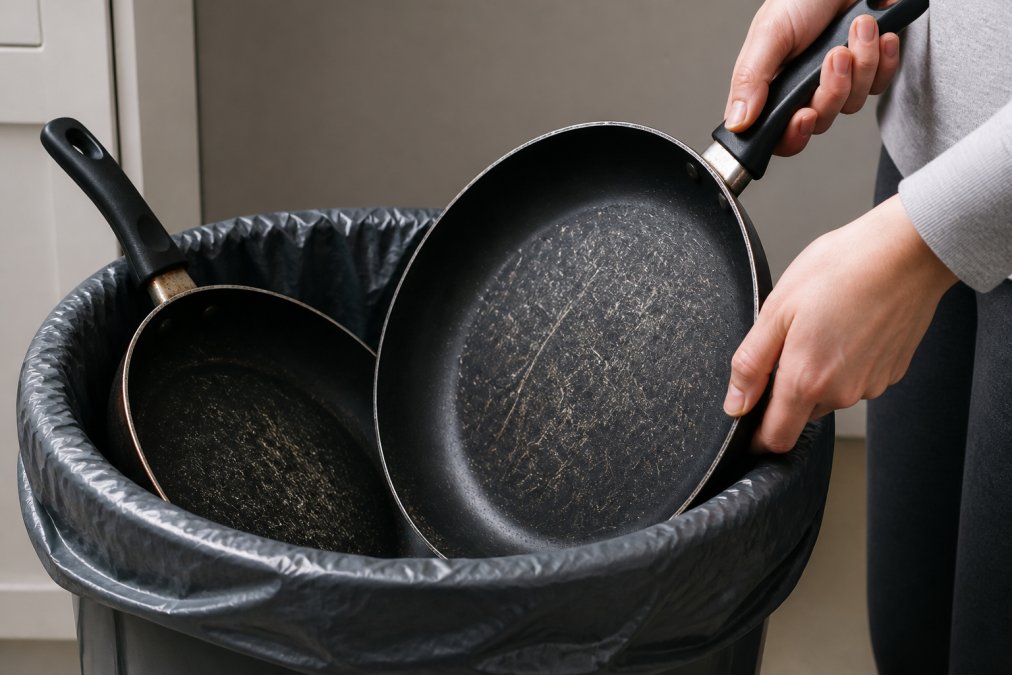
The visual cues that a non-stick pan has reached the end of its safe life are easier to spot than most people think. If you can see any of the following signs, the coating has failed and the pan should be retired: visible grey or silver scratches, flaking or peeling patches, a rough or sticky surface where food used to release easily, or discolouration that won't wash off.
The most obvious red flag is seeing the underlying metal. When the coating has worn through to the base material, there is no longer a barrier between your food and the pan's construction. Dark spots or a mottled appearance often indicate where the coating has thinned and is about to flake. Run your finger across the surface; if it catches on any rough patches, those are active release points.
For households with young children, err on the side of caution. Children's developing bodies are more vulnerable to environmental contaminants, and their smaller size means any ingested material has a proportionally larger impact. If a pan shows any of these warning signs, it's not worth the risk of keeping it in rotation.
When to Replace Non-Stick Pans: Your Safety Checklist
Knowing when to replace non-stick pans comes down to a simple safety checklist that takes less than a minute to run through. This is the framework we recommend for every client making the switch to non-toxic cookware alternatives.
- Check the surface for scratches. Any visible scoring through the coating means it's time to go.
- Look for flaking or peeling. If you see pieces of coating lifting away, those particles are landing in your food.
- Test the release. If food is sticking where it once slid freely, the coating has degraded.
- Consider the age. Non-stick pans are not lifetime purchases; even the best quality coatings wear down with regular use.
- Smell during heating. An unusual chemical or plastic odour when the pan warms up signals thermal breakdown of the polymer.
Repair vs. Replace: Can You Fix a Damaged Coating?
The honest answer to whether you can repair a scratched non-stick pan is no, and understanding why helps you avoid wasting money on ineffective fixes. The chemical composition of non-stick coatings is applied in a factory setting under controlled heat and pressure. No home remedy, re-seasoning oil, or coating spray can restore the original polymer structure.
The repair versus replace decision becomes straightforward when you consider the cost per use. A scratched pan that must be replaced every few months costs more over time than a durable, uncoated pan designed to last for years. This is where the economics of non-toxic cookware alternatives start to make sense for budget-conscious families.
Non-Toxic Cookware Alternatives That Last
Choosing a replacement for scratched non-stick pans involves more than picking the safest material; it requires matching the material to your cooking style, kitchen setup, and willingness to adapt your techniques. The three main uncoated options, stainless steel, cast iron, and carbon steel, each have distinct trade-offs that suit different households.

Stainless steel is the closest replacement for non-stick in terms of maintenance. It is dishwasher safe, does not require seasoning, and withstands high heat without any risk of coating degradation. The trade-off is that food will stick to the pan is not preheated correctly or if insufficient fat is used. A common technique is the water droplet test: heat the pan dry, then flick a few drops of water onto the surface. If the water forms a dancing bead rather than evaporating instantly, the pan has reached the correct temperature for adding oil.
Cast iron offers the closest non-stick experience once properly seasoned, because the polymerised oil layer creates a natural release surface. It also provides superior heat retention, making it excellent for slow cooking and high-heat searing. The trade-offs are weight, maintenance, and reactivity. Cast iron must be dried thoroughly after washing to prevent rust, and it should not be washed with soap that strips the seasoning. Acidic foods like tomatoes or vinegar can react with the iron, imparting a metallic taste if cooked for extended periods. For households that cook a variety of cuisines, this limitation can be frustrating.
Carbon steel sits between stainless and cast iron. It is lighter than cast iron, seasons similarly, and is favoured by professional chefs for wok cooking and omelettes. It requires the same care as cast iron, drying, oiling, and avoiding prolonged exposure to acidic ingredients. It is not dishwasher safe and will rust if neglected.
Ceramic-coated pans are often marketed as a non-toxic alternative, but they are not uncoated. They use a sol-gel coating derived from silica, which is free of PFAS, but this coating is more fragile than PTFE and tends to lose its non-stick properties within six to twelve months of regular use. Once the ceramic coating degrades, it can chip and flake into food, presenting a similar particle ingestion concern to scratched PTFE, albeit without the PFAS chemical risk.
For Australian households, the decision often comes down to lifestyle. Families with young children or those who value convenience may prefer stainless steel for its dishwasher-safe durability. Enthusiast cooks who enjoy the ritual of care may prefer cast iron or carbon steel for their superior cooking performance. The Choice Australia's cookware buying guide recommends considering weight, handle comfort, and compatibility with your cooktop, induction cooktops require magnetic materials, which all three uncoated options satisfy.
A practical approach is to transition gradually. Replace the most-used pan first, typically the 24-28 cm frying pan, with a stainless steel version, and keep a well-seasoned cast iron skillet for eggs. This allows you to learn each material's quirks without overhauling your entire kitchen at once. The goal is not to find a perfect non-stick substitute, but to adopt cookware that will not degrade into your food, regardless of how many scratches it accumulates over the years.
Making the Switch Without the Stress
Transitioning from non-stick to stainless steel does require a small adjustment in cooking technique, but the learning curve is shorter than most people fear. The common worry is that food will stick to stainless steel. In practice, preheating the pan properly and using adequate fat creates a release that works for most everyday cooking tasks.
Making the switch to non-stick-free cookware is about removing the mental load of monitoring coatings, not adding a second job to your cooking routine. With dishwasher-safe, uncoated stainless steel, you get durable pans that handle everyday meals, travel well, and eliminate the health concerns of scratched non stick pans entirely.
The challenge of scratched non-stick pans is that the damage is invisible until it's already affecting your food. Rather than tracking scratches and wondering when to replace another pan, switching to uncoated stainless steel removes the question altogether. The Low Tox Project offers uncoated, food-grade stainless steel bakeware and cookware that is durable, dishwasher safe, and free from the flaking and plastic concerns of coated alternatives. Cook with confidence, knowing your pans are built to last without the coating worry.