
Last Updated: 5 November 2026
Quick Summary
Yes, it is safe to use metal utensils stainless steel pans can handle, provided the pan is uncoated. Bare stainless steel is metal all the way through, so there is no coating to flake or chip, though metal tools may leave faint cosmetic marks. On coated or hybrid surfaces, play it safer with wood or silicone.
- Metal transfer looks like a faint grey mark that sits on top of the surface rather than cutting in.
- Run your fingernail across a mark: if it glides over, it is likely surface-level.
- Use a metal spatula at a shallow angle, sliding under food rather than digging into the pan.
- A paste of bicarbonate of soda and water handles most metal transfer marks gently.
- Your manufacturer's instructions are the final word on what your specific pan can handle.
Table of Contents
- The Short Answer: Metal Utensils and Uncoated Stainless Steel
- Can Metal Utensils Scratch Stainless Steel Pans?
- Bare Stainless Steel Versus Non-Stick and Hybrid Surfaces
- Choosing the Best Utensils for Stainless Steel Cookware
- How to Use a Metal Spatula and Turner Without Causing Harm
- Stainless Steel Cookware Care That Actually Extends Its Life
- Removing Metal Marks and Checking Your Manufacturer's Instructions
- Stocking Your Kitchen with Utensils That Work With Your Pans
- Frequently Asked Questions
The Short Answer: Metal Utensils and Uncoated Stainless Steel
Yes, it is safe to use metal utensils stainless steel pans can handle, provided the pan is uncoated. This is one of the questions we hear most often at The Low Tox Project, usually from someone standing in their kitchen holding a scratched non-stick pan and a metal spatula, wondering what to do next. The short answer is that bare stainless steel is tough. It does not flake, peel or chip the way a coating can, so a metal spoon or spatula generally will not harm it.
That is the good news. The slightly less good news is that metal utensils can leave marks. These are usually cosmetic, not a sign that your pan is failing. Once you know what to look for, the whole thing becomes much less worrying.
Why the Surface Type Changes Everything
A stainless steel pan is metal all the way through. There is no coating to scratch off, so there is nothing to flake into your food. Non-stick pans work differently. Their surface is a layer applied over the base, and that layer can wear away over time, especially with rough tools.
This is why the advice splits so sharply. Metal on bare stainless steel is generally fine. Metal on a coated surface is where problems can start. If you are ever unsure which type you have, check the base of the pan or the manufacturer's instructions.
Can Metal Utensils Scratch Stainless Steel Pans?
Metal utensils can scratch stainless steel pans, but the scratches are usually superficial. Stainless steel is a hard material, and a spatula or spoon is softer than the pan in most cases. What you often see is metal transfer: a faint grey mark left on the surface where the utensil has rubbed against it. That mark sits on top rather than cutting in.
Deeper grooves are possible if you scrape hard with a sharp edge, or if the utensil itself is rough or damaged. Even then, a scratch on bare stainless steel is not the same as a health concern. It does not expose a coating, because there is no coating.
Cosmetic Marks Versus Damage That Matters
Here is where a bit of knowledge helps. A cosmetic mark is a change in appearance only. The pan still heats evenly, the surface is still intact, and food still cooks the same way. A mark that matters is one you can feel as a deep groove, or one that comes with warping, pitting or a change in how the pan performs.
A simple test: run your fingernail gently across the mark. If it glides over, it is likely surface-level. If your nail catches in a groove, it is deeper, though still usually harmless on an uncoated pan. Watch out for pitting, which looks like small dark dots or rough patches, as this is worth checking against your manufacturer's guidance.
Bare Stainless Steel Versus Non-Stick and Hybrid Surfaces
Surface type is the single biggest factor in whether metal utensils are a good idea, and it is also where most of us get stuck.
Bare stainless steel is metal through and through. There is no applied layer, so there is nothing to chip, flake or peel. A metal spatula might leave a faint mark, but it cannot expose a coating that is not there. Non-stick pans are different.
So how do you tell which one you have? A few checks usually settle it. Look at the colour and texture of the cooking surface: bare stainless steel is metallic and reflective, while a non-stick or hybrid finish tends to look matte, speckled or evenly coloured.
The practical upshot is simple. On bare stainless steel, reach for metal with confidence. If you are moving away from non-stick and want to understand the concerns around worn coatings, our article on the dangers of scratched non-stick pans explains what to look out for.
Surface type is the biggest factor in whether metal utensils are a good idea, so here is how the main surfaces compare.
| Surface | Construction | Metal utensils |
|---|---|---|
| Bare stainless steel | Metal all the way through, no applied layer | Generally fine; may leave faint cosmetic marks |
| Non-stick | Release surface applied over a base | Rough or sharp tools can speed up wear |
| Hybrid | Textured or coated finish with a metal base | Generally behaves more like a coated pan |
Choosing the Best Utensils for Stainless Steel Cookware
The best metal utensils stainless steel cookware can pair with are smooth, sturdy and free of rough edges. Metal is a perfectly reasonable choice on an uncoated pan, and it has real advantages. Metal tools are generally durable and easy to clean.
Wood and silicone have their place too. Wood is gentle and quiet against the surface, though it needs hand washing and occasional oiling. Silicone is flexible and good for scraping, but check that it is heat rated for the temperatures you cook at. A mix works well for most kitchens: metal for flipping and turning, wood or silicone for gentler tasks.
A few things to look for when buying:
Stainless Steel Coffee Spoon →
- Smooth, rounded edges with no burrs or chips
- A sturdy handle that stays cool
- A size that suits your pans, so you are not scraping at awkward angles
- Dishwasher suitability, if that matters to you
If you are building out a set of uncoated cookware, our stainless steel cookware collection is designed to work with metal utensils and made without non-stick coatings.
How to Use a Metal Spatula and Turner Without Causing Harm
Technique matters more than the tool itself. Use a metal spatula at a shallow angle, letting the flat edge slide under the food rather than digging into the pan. Lift and turn rather than stab or scrape hard. When you are deglazing or stirring, let the utensil follow the curve of the pan instead of jabbing at the base.
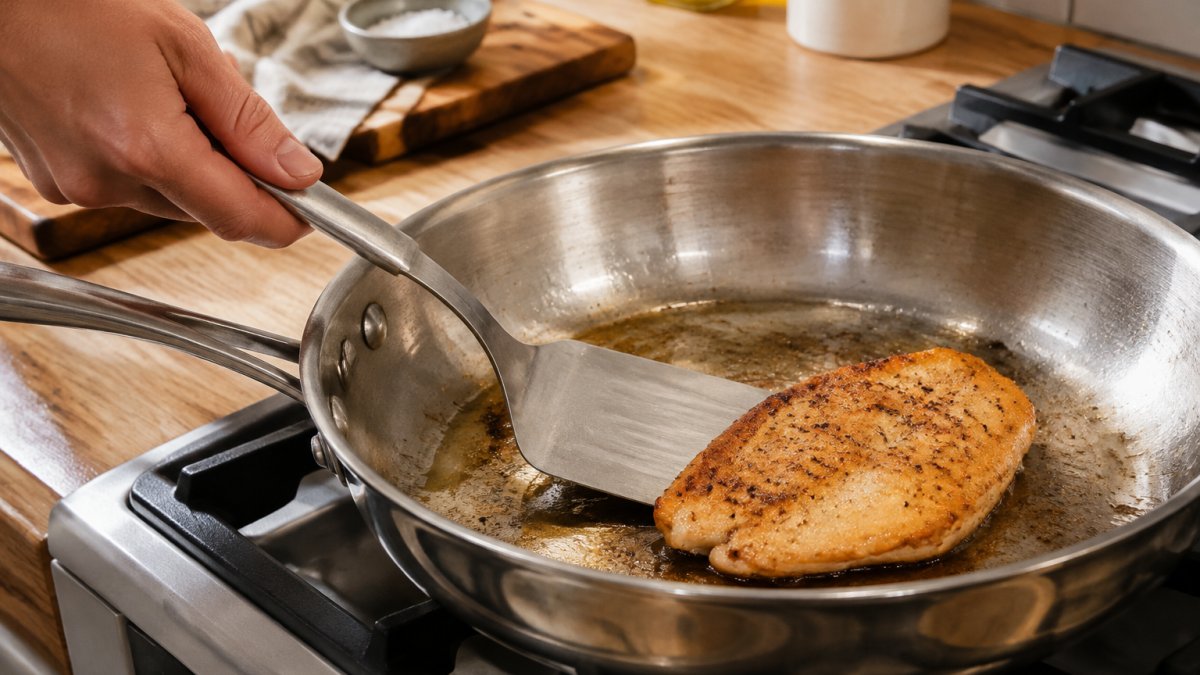
A common mistake is using the corner of a spatula to scrape at stuck bits. That is where deeper marks come from. Instead, add a splash of liquid and let it loosen the food, then stir gently. The same goes for a metal spoon: stir in a smooth motion rather than chopping at the base. Good technique keeps your pans looking better for longer, and it is easier on your wrists too.
Stainless Steel Cookware Care That Actually Extends Its Life
Good care is mostly about small habits. Wash your pans with warm water and a soft cloth or sponge. For stuck-on food, soak first rather than scrubbing hard with an abrasive pad. Avoid steel wool on polished surfaces, as it can dull the finish. Dry your pans properly after washing to keep water spots at bay.
Dishwasher suitability varies by product, so check your manufacturer's instructions rather than assuming. Some stainless steel pieces are dishwasher safe, others are better hand washed. If you want the detail, our guide to dishwasher safe stainless steel cookware covers what makes a piece suitable and how to handle common marks. Store pans without stacking them roughly, and use a cloth or felt pad between them if space is tight.
Removing Metal Marks and Checking Your Manufacturer's Instructions
Most marks left by metal utensils are surface-level and lift off with a little effort. The trick is matching the method to the mark and to the finish, rather than reaching for the strongest abrasive in the cupboard.
Metal transfer usually looks like a faint grey or dark streak where the utensil has rubbed against the pan. It sits on top of the surface rather than cutting into it, which is why it often comes away easily.
It helps to know what you are looking at before you start scrubbing. A cosmetic mark changes appearance only: the pan still heats evenly and the surface is intact. If you want natural fixes for common issues like rainbow streaks or pitting, our article on common stainless steel cookware issues walks through them step by step.
Your manufacturer's instructions are the final word here. They tell you what your specific pan can handle, whether it is oven safe, and how to care for it. Keep the manual or note the model, because care advice varies between products.
Stocking Your Kitchen with Utensils That Work With Your Pans
A well-chosen set of utensils makes everyday cooking simpler. You do not need a drawer full of gadgets. A metal spatula, a sturdy spoon, a turner and a pair of tongs cover most tasks. Add a wooden spoon or two for gentler jobs, and you are set.
Our stainless steel kitchenware collection includes practical pieces for cooking, serving and everyday use. The long handled stirring spoon reaches into deep jars and pots, while the rice spoon is shaped for serving without scratching. For bakers, the dough cutter handles pastry and bread with clean precision.


Buying less and choosing well is at the heart of what we do. A few good tools, cared for properly, will serve you for years.
Metal utensils and stainless steel are a genuinely good match once you understand the surface you are working with. The challenge is knowing which pans are uncoated and which are not, and then building a small, reliable set of tools around them. At The Low Tox Project, we offer uncoated stainless steel bakeware and kitchenware designed for everyday cooking.
Frequently Asked Questions
Can you use metal utensils on stainless steel cookware?
Yes, you can generally use metal utensils on uncoated stainless steel cookware. The surface is hard enough to handle metal spatulas, spoons and turners without the deep scratching you would get on a non-stick coating. You may notice light grey marks or superficial scratches over time, but these are usually cosmetic and do not affect how the pan performs. Always check your cookware manufacturer's instructions first, because some brands specify particular utensil types or care requirements.
Will metal utensils scratch stainless steel pans?
Metal utensils can leave superficial scratches and cosmetic marks on stainless steel pans, but these are different from damage that affects performance. A light scratch in the surface does not stop the pan from heating evenly or cooking food properly. Deep gouges are less common and usually come from heavy force rather than normal cooking. Using a gentle scraping motion and avoiding sharp-edged tools helps keep marks to a minimum. If you are unsure, your cookware manual will tell you what the manufacturer recommends.
Are wooden or silicone utensils better for stainless steel?
Wooden and silicone utensils are softer than metal and will not leave marks on stainless steel, so they are a good option if you prefer a spotless surface. However, metal utensils are more durable, easier to clean and better for scraping up browned bits when you are cooking. Many households use a mix: metal for everyday frying and flipping, and wooden or silicone for gentler tasks. The best utensils for stainless steel cookware are the ones that suit how you actually cook.
How do you remove utensil marks from stainless steel?
Light metal marks on stainless steel usually come off with a gentle clean. Make a paste from bicarbonate of soda and water, rub it over the mark with a soft cloth, then rinse and dry. For tougher marks, a stainless steel cleaner or a little white vinegar can help. Avoid steel wool or harsh abrasives, which can scratch the surface further. Always follow your cookware manufacturer's cleaning instructions, and check whether your pans are dishwasher safe before choosing that option.