Last Updated: November 4, 2026
Quick Summary
Stainless steel ice block moulds are a sturdy, food-grade option for homemade ice blocks, and we offer two designs in 304 food-grade stainless steel. The round design suits busy households and little hands, while the flat design suits anyone who prefers a sleek look and a stable freeze.
- Both designs are six-mould sets on a sturdy stand, made from 304 food-grade stainless steel.
- The round design costs $68.00 AUD and offers easy filling, while the flat design costs $64.00 AUD.
- Run lukewarm water briefly over the mould rather than hot water, to loosen blocks without melting them.
- Never lever a knife or spoon between the block and the mould, as this can scratch the interior finish.
- Both designs are listed as dishwasher safe, and a soft sponge is enough for everyday cleaning.
Table of Contents
- Why Stainless Steel Ice Block Moulds Are Worth Considering
- Our Two Stainless Steel Ice Block Mould Designs Compared
- How to Remove Ice Blocks from Stainless Steel Moulds
- Stainless Steel Ice Block Mould Recipes to Try This Summer
- Cleaning, Dishwasher Use and Looking After Your Moulds
- Freezer Space, Storage and Choosing Between Round and Flat
- Pick the Mould That Suits Your Freezer and Your Family
- Frequently Asked Questions
Why Stainless Steel Ice Block Moulds Are Worth Considering
Summer afternoons go much better with a homemade ice block in hand, and a good mould is the easiest way to make them. Most people reach for cheap plastic moulds that crack, warp or hold onto old flavours. Stainless steel is a different story. It is a sturdy, food-grade option that we think makes a practical, long-lasting swap.
Our moulds are made from 304 food-grade stainless steel, and our product listings describe it as durable and rust-resistant. Depending on how often you make ice blocks, a set can become a regular part of your summer routine.
Ice block moulds are a good fit if you want to make your own fruit juice, yoghurt or smoothie treats without buying single-use packaged versions. They also suit families who prefer to skip plastic where they can. Stainless steel moulds are not the only option, but they are a sensible choice if you want something that is simple to clean and built to be used again and again.
Our Two Stainless Steel Ice Block Mould Designs Compared
We currently offer two designs, and each one suits a slightly different kitchen. Both are made from 304 food-grade stainless steel and are listed as dishwasher safe.
| Design | Price (AUD) | Best For | Finish |
|---|---|---|---|
| Ice Block Mould Stainless Steel Round | $68.00 | Easy filling and little hands | Smooth round shape |
| Ice Block Mould Stainless Steel Flat | $64.00 | A sleek look and a stable freeze | Brushed matte finish |
Our listings describe both as six-mould sets with a sturdy stand, so you can compare the designs on looks, handling and storage rather than capacity alone.


Round Moulds: Easy Filling and Little Hands
The round design is the one we would suggest for busy households. The smooth round shape makes it easy to pour in juice, yoghurt or smoothie and to pop the blocks out again. It is also a comfortable shape for little hands to manage.
Our round moulds are compatible with both reusable and wooden sticks, so you can mix and match combinations as you like. The sturdy stand keeps each mould upright in the freezer, which helps avoid spills.
Flat End Moulds: A Matte Finish and Stable Freeze
The flat end design has a squared-off base that gives the ice blocks a contemporary silhouette. Its brushed matte finish is a nice touch if you prefer a more understated look in your kitchen. Our listing notes that the brushed external finish is designed to resist scratches.
How to Remove Ice Blocks from Stainless Steel Moulds
Removal is where most people get stuck, so here is how to release a block without too much guessing.
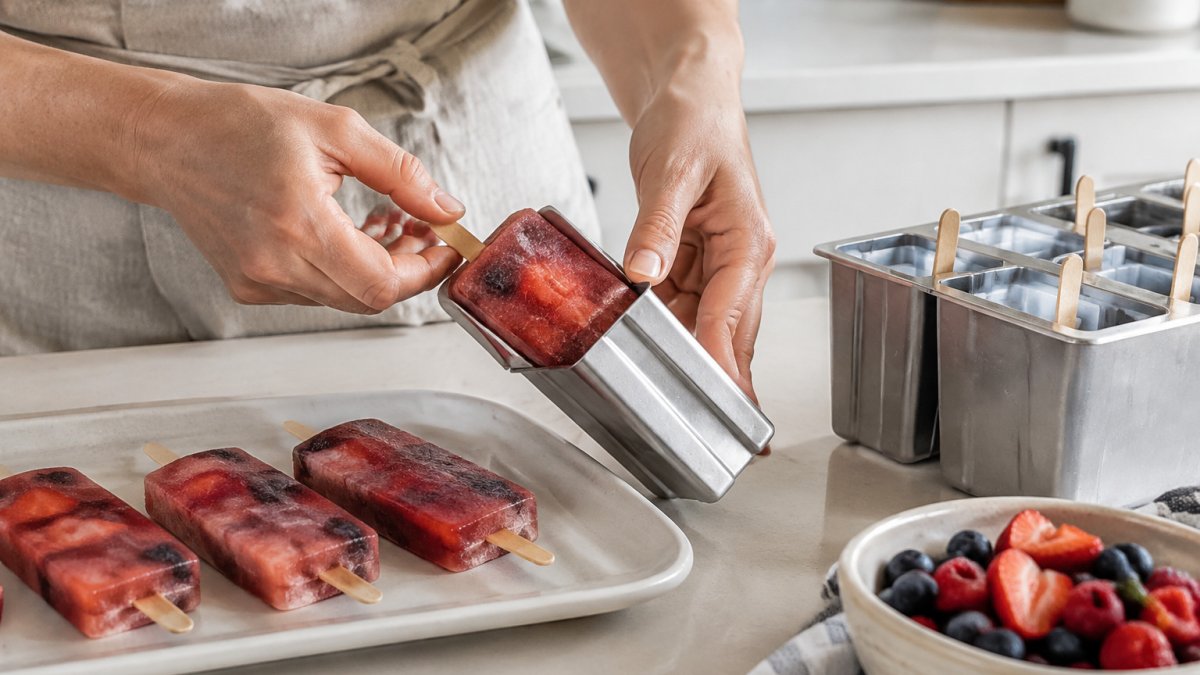
Stainless steel conducts heat quickly, so a brief run under lukewarm water helps warm the mould. Use short bursts of lukewarm water rather than hot, as hot water can melt the outer layer of the block before the centre has loosened.
Here is the sequence we use at home:
- Fill a shallow bowl or the sink with a few centimetres of lukewarm water.
- Stand the mould in it for 10 to 20 seconds, just enough to warm the metal.
- Lift the mould out, hold the stick firmly near the base and give it a gentle twist rather than a pull.
- If the block moves, ease it out slowly. If it does not, repeat once more.
Watch out: never lever a knife or spoon between the block and the mould wall. Stainless steel is tough, but a thin blade can scratch the interior finish, and a scratched surface makes the next block grip harder.
If a block is genuinely stuck, work through these checks before forcing anything:
The block is too cold. A block frozen solid at the back of the freezer can grip tightly. Move the mould to the fridge for five minutes rather than the bench. A slow warm-up loosens the surface without melting the middle.
The stick is the problem, not the block. Wooden sticks absorb moisture and can swell slightly, wedging themselves in. If the stick will not budge but the block feels loose, twist the stick gently on its own axis first, then lift.
The mould was overfilled. If liquid rose above the fill line, it may have frozen around the rim and locked the block in. Run lukewarm water around the rim specifically, not just the base.
The block has a hollow centre. Yoghurt and smoothie blocks sometimes freeze with an air pocket that makes them collapse when pulled. Wiggle rather than pull, and let the block slide out under its own weight.
It is a layered block. If you froze in stages, the layers can bond unevenly to the mould wall. A few extra seconds in the water bath usually sorts this out.
The first block of a batch can be the hardest to release, since the mould is coldest on that first attempt. Once the metal has warmed slightly, subsequent blocks usually come out more readily.
Ice Block Mould Stainless Steel Round →
If you are making blocks for little hands, the round design can be easier to work with, as its smooth curve gives you more surface to warm evenly.
Stainless Steel Ice Block Mould Recipes to Try This Summer
The best part of a stainless steel mould is how versatile it is. Our round and flat moulds work with simple ingredients you probably already have in the fridge.
Try these ideas:
- Fruit juice blocks: Pour in your favourite no-added-sugar juice and freeze.
- Yoghurt and berry: Layer plain yoghurt with mashed berries for a creamy treat.
- Smoothie pops: Blend banana, spinach and mango for a colourful option.
- Layered blocks: Freeze one layer, then add the next once it has set for a striped look.
Experiment with what your family enjoys. Because the moulds are reusable, you can try new combinations each week without adding waste to the bin.
Cleaning, Dishwasher Use and Looking After Your Moulds
Our listings describe both designs as dishwasher safe. Rinse the moulds after use, then pop them in the dishwasher or wash by hand with warm soapy water. Stainless steel does not need seasoning, so there is no special treatment required before you use them.
To keep them looking their best, avoid harsh abrasive scourers that could mark the finish. A soft sponge is usually all you need. Dry them thoroughly before storing, especially if you are putting them away in a cupboard.
If you have specific questions about care or dishwasher settings, your product care information is a good place to check.
Freezer Space, Storage and Choosing Between Round and Flat
A six-mould set with a stand takes up more freezer real estate than most people expect, and this is the single most common reason a mould ends up relegated to the back of a cupboard. Planning for it before you buy is worth five minutes of measuring.
Both of our designs are six-mould sets on a sturdy stand, which keeps each mould upright so the sticks freeze straight and the blocks come out evenly shaped. Measure the height clearance of your freezer shelf as well as the width, because a stand plus sticks needs vertical room too. If your freezer has a wire shelf rather than a solid one, a small tray or chopping board underneath stops the stand from wobbling.
The round and flat designs differ in how they use that space. The flat end moulds have a wider, squared base and occupy a broader footprint, so measure before you buy.
A few storage habits that make a real difference:
- Keep the stand assembled between batches. Rebuilding it each time is the fastest way to lose parts.
- Store the moulds empty and dry, not stacked inside each other, so the interior finish stays unscratched.
- If you make blocks in batches, freeze one set while the other is in use, then rotate. Two sets take less space than you think when one is always in the freezer and one is on the bench.
- Label the shelf or drawer where the set lives so other household members do not shuffle it.
If freezer space is genuinely tight, it is worth being honest about how many blocks you will make at once. A single set of six is plenty for most households, and buying a second set you cannot store is not a saving. Our philosophy is buy less and choose well, and that applies to freezer space as much as to cupboards.
For keeping treats cold when you are out and about, our Stainless Steel Ice Brick is a handy companion for lunchboxes and eskys, and it stacks flat when not in use. If you are reorganising kitchen storage more broadly, our Stainless Steel Cooling Rack Mini fits neatly in our mini oven trays and is a good reminder that a little planning across the bench and oven pays off.

Round or flat comes down mostly to your household. Choose round if you want easy filling, a tighter freezer footprint and a set that suits little hands. Choose flat if you prefer a sleek look, a stable uniform freeze and you have a flat shelf or drawer to dedicate to it.
Pick the Mould That Suits Your Freezer and Your Family
Both designs are a practical way to make your own ice blocks at home, and both are made from 304 food-grade stainless steel. Think about how you will use them, how much freezer room you have and which look you like best.
If you are shopping for someone else, a Gift Card lets them choose the design that suits their kitchen. Whichever mould you pick, we hope it becomes a favourite part of your summer.
Frequently Asked Questions
Are stainless steel ice block moulds better than plastic?
Stainless steel is a sturdy, reusable option that can last through many summers of use. Our moulds are made from 304 food-grade stainless steel and are rust-resistant. Plastic can be lighter and cheaper to buy, so it really comes down to what matters most to you. If you want something that lasts for years of summer use, stainless steel is worth a look.
How do you get ice blocks out of stainless steel moulds?
Run the outside of the mould under lukewarm water for 10 to 20 seconds, then gently ease the ice block out by pulling on the stick. Avoid hot water, as it can melt the outside of the block too quickly. Patience works better than force, so try not to pull too hard on the stick.
Are stainless steel ice block moulds dishwasher safe?
Our Ice Block Mould Stainless Steel Flat and Round moulds are listed as dishwasher safe. Other stainless steel moulds may differ, so always check the product's own care instructions. A quick rinse straight after use also stops juice and yoghurt from drying on.
Do stainless steel moulds rust?
Stainless steel is rust-resistant, which is one of the main reasons it's a practical choice for kitchen use. It isn't completely immune to rust, though, especially if it's left wet for long periods or exposed to harsh cleaners. Drying your moulds after washing and avoiding abrasive scourers will help keep them looking good for years.