
Last Updated: November 4, 2026
Quick Summary
Generally, yes. Enamelled cast iron from a reputable maker is considered suitable for everyday cooking, as the glass enamel coating is generally non-reactive with acidic foods. Check the coating is smooth and unbroken, and buy from a brand that shares its safety information.
- Buy from a known maker that follows testing standards for its enamel.
- Check the interior coating is smooth and unbroken before cooking with it.
- Avoid storing highly acidic leftovers in the pan for days; transfer them to glass or ceramic.
- Stop using a pan with interior chips that expose bare metal, especially for acidic dishes.
- Avoid thermal shock by heating gently and letting hot pans cool before washing.
Table of Contents
- What Enamelled Cast Iron Actually Is
- Is Enamelled Cast Iron Non-Toxic for Everyday Meals?
- Does Enamel Stay Non-Reactive With Acidic Food?
- What to Do If Your Enamelled Pan Is Chipped
- Caring for Enamelled Cast Iron Day to Day
- Enamelled Cast Iron Versus Bare Cast Iron
- Choosing Your Next Pan With Confidence
- Frequently Asked Questions
What Enamelled Cast Iron Actually Is
If you've been eyeing a shiny enamelled casserole dish, you're probably wondering what it's actually made of. The short answer: it's a cast iron pan with a glassy coating fused onto the outside and inside. That coating is called enamel, and it's essentially powdered glass baked on at very high heat.
The cast iron underneath does the heavy lifting. It holds heat well and spreads it evenly, which is why these pans are so good for slow braises and soups. The enamel sits on top, so you don't need to season it the way you would bare cast iron.
The coating is smooth and generally doesn't react much with food. That's the part most people care about, and it's where the safety questions come from. We'll get to those next.
Is Enamelled Cast Iron Non-Toxic for Everyday Meals?
Generally, a well-made enamelled pan from a reputable maker is considered suitable for everyday cooking.
That said, "non-toxic" is a big word, and we'd rather be careful than overpromise. Here's what matters most:
- Buy from a known maker. Reputable brands follow testing standards for the enamel they use.
- Check the coating is intact. A smooth, unbroken surface is what you want.
- Ask for the manufacturer's safety information. Good makers will tell you what their enamel is tested against.
We don't think there's any need to panic about everyday meals. Plenty of people cook in enamelled pans every day without a second thought.
Does Enamel Stay Non-Reactive With Acidic Food?
This is one of the most common questions we hear. Enamel is generally considered non-reactive, which means it doesn't usually react with acidic ingredients like tomato sauce, wine or citrus the way bare cast iron can.
Bare cast iron can react with acidic foods, giving them a metallic taste and sometimes a grey tinge. Enamel generally avoids that because the glass coating sits between the food and the metal.
Even so, it's a good idea to avoid storing highly acidic leftovers in the pan for days on end. Transfer them to a glass or ceramic container once they've cooled. It's a small habit that keeps your pan looking its best.
What to Do If Your Enamelled Pan Is Chipped
Chips are one of the few genuine safety questions with enamelled cast iron, and they're also where most advice online gets fuzzy. A chip on the outside of a casserole dish is a cosmetic annoyance. A chip on the cooking surface is a different conversation, because the enamel is the barrier between your food and the cast iron underneath. Treating every chip as equivalent either makes you throw out a perfectly good pan or keeps using one you shouldn't.
The first thing to understand is that enamelled cast iron usually has more than one enamel surface. There's the interior coating that touches food, the exterior coating that faces the hob, and often a decorative band or rim around the top. These can be different formulations and different thicknesses, and a chip in the decorative rim tells you very little about the state of the cooking surface. When you inspect damage, look specifically at the interior base and walls, not just the part you can see from across the kitchen.
A practical inspection goes like this. Wash and dry the pan, then run a fingernail gently across the damaged area. If your nail catches on a sharp edge, the enamel has lifted rather than simply marked. Shine a torch across the surface at a low angle, because hairline cracks and crazing (the fine web of surface lines that can appear with age) show up far better in raking light than in overhead light. Crazing alone isn't automatically a reason to stop cooking, but it's worth monitoring, and many manufacturers will ask for a photo of exactly this kind of detail if you contact them.
From there, the decision usually falls into three buckets. A small chip on the exterior, away from the food contact area, is generally fine to keep using, provided you dry the exposed spot thoroughly after washing so the cast iron underneath doesn't start to rust. A chip on the interior that exposes bare metal is the one to take seriously, especially if you cook tomato-based dishes, wine reductions or anything acidic, because the exposed iron can react with the food and the enamel edge can continue to lift. Stop using it for those dishes and contact the manufacturer about whether the pan is covered. Cracks, flaking that spreads, or enamel that has lifted in sheets are a clear signal to retire the pan, because damaged enamel can't be resealed at home and no coating you apply will replicate the original fired finish.
Enamel damage can sometimes worsen over time, so it's worth checking a chipped spot again after a few washes rather than assuming it's settled.
If you're unsure, the manufacturer is the right first call, not a forum. Have the model name, approximate age and a clear photo ready, and ask specifically whether the damage is within the food contact area and whether they consider it a warranty matter. Warranty terms vary between brands, and it's better to check than to guess. If the pan is out of warranty and the interior is compromised, it can still have a second life as a dedicated bread baker or a planter, just not as a vessel for acidic dinners.
Caring for Enamelled Cast Iron Day to Day
Thermal shock is a common cause of enamel damage, and it's the stress that builds when one part of the pan is much hotter or colder than another. Enamel is a glass layer fired onto cast iron, and glass and metal expand at different rates. Heat them or cool them unevenly and the enamel can crack, craze or lift, often weeks after the event that caused it. Once you understand that, the daily routine mostly writes itself.
On the hob, start low and build up. Cast iron holds heat well, so a medium setting is often enough for a simmer, and preheating gently on low for a few minutes is kinder to the enamel than slamming it onto a high flame. Keep the flame or element within the base of the pan where you can, because flames licking up the enamelled sides is one of the more common causes of exterior discolouration and stress. If you're using an induction hob, check the manufacturer's guidance on the maximum ring size, as an oversized ring can heat the sides faster than the base.
In the oven, temperature limits vary by brand and by whether the lid has a metal or plastic knob. Check your specific pan's instructions rather than assuming, and never put a cold pan into a hot oven or a hot pan onto a cold worktop. Let it sit on a trivet or a dry tea towel for a few minutes. The same principle applies to washing: a hot pan under cold water is the classic way to crack enamel, so let it come down to warm before you clean it.
Utensils matter more than people expect. Wooden spoons, silicone spatulas and nylon tools are the safe default. Metal tongs and whisks can scratch the interior over time, and while light scratches are usually cosmetic, deep ones give food and moisture somewhere to sit. If you do use metal, keep it off the base and away from the edges where the enamel is thinnest.
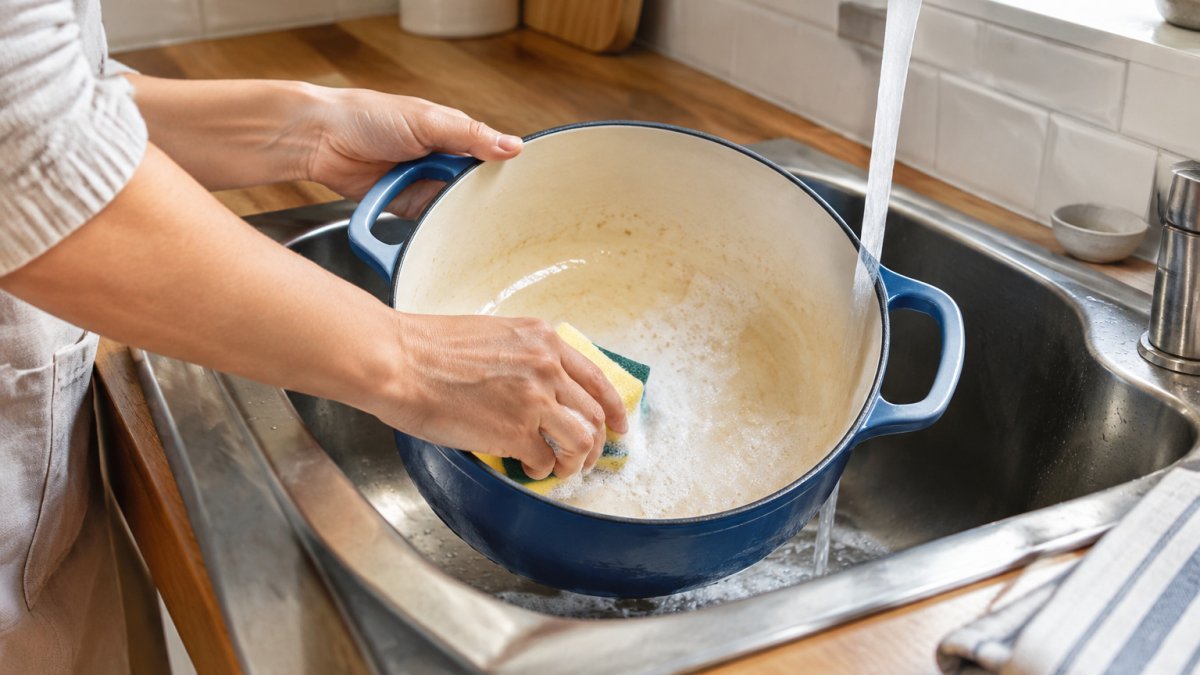
Cleaning is where most day-to-day frustration lives, and it's usually solvable without scrubbing. For everyday residue, warm water, a little washing-up liquid and a soft sponge are enough once the pan has cooled. For stuck-on food, fill the pan with warm water and a drop of washing-up liquid and leave it for twenty minutes or so, then wipe. For the pale interior stains that come from tea, coffee or long braises, a paste of bicarbonate of soda and water applied for ten minutes and rinsed well lifts most of it. For mineral film or rainbow discolouration, a small amount of white vinegar diluted in water usually helps, though it's worth rinsing thoroughly afterwards. Avoid steel wool, abrasive powders and oven cleaners, which can dull or pit the surface.
Dishwasher use is brand-dependent, so it's worth checking your pan's care instructions before loading it. If your pan is a daily workhorse, handwashing is the gentler option, and it takes less time than most people expect once the pan has soaked. Always dry thoroughly, especially around the rim and any exposed cast iron, before putting it away.
Watch out: the rim of an enamelled pan can be a spot where bare cast iron is exposed. If water sits there, it may rust, so it's worth drying it properly rather than letting it air dry on the rack.
If you're building out a kitchen that's designed to last, the same buy-less-choose-well logic applies to bakeware. Our stainless steel baking trays, muffin pans and bread pans are designed for everyday baking, and greasing them with butter, oil or ghee before use is all they need. If you're weighing up materials more broadly, our guide on cast iron cookware and healthy cooking is a useful next read.
Enamelled Cast Iron Versus Bare Cast Iron
Both are cast iron, but they suit different cooks. Bare cast iron is a classic choice for searing and frying, and it needs careful drying to avoid rust.
Enamelled cast iron is lower maintenance. It's happy with acidic ingredients, and it's lower maintenance than bare cast iron. It's a strong choice for soups, stews and braises, though it can be heavier and more expensive than bare cast iron.
Learn more about cast iron cookware and whether it suits healthy cooking if you're weighing up your options.
Neither is better across the board. It really depends on what you cook most and how much maintenance you want.
Choosing Your Next Pan With Confidence
When you're choosing an enamelled pan, look for a reputable maker, a smooth and unbroken coating, and clear care instructions. Think about the kinds of meals you cook most often, because that will tell you whether enamelled or bare cast iron makes more sense.
If you're also looking at stainless steel, which is what we specialise in at The Low Tox Project, our range of bakeware and kitchenware is designed for everyday cooking.
Frequently Asked Questions
Is enamelled cast iron safe for daily cooking?
For most people, enamelled cast iron is a practical choice for everyday cooking. The enamel is a glass-like coating fused to the iron, which gives a smooth surface that is generally considered suitable for tomato sauces, stews and braises. As with any cookware, it works best when you follow the manufacturer's guidance on heat levels and cleaning. If you have specific health questions, it's worth speaking with your GP.
Can enamelled cast iron be used on high heat?
Enamelled cast iron generally performs best at low to medium heat. Heating it gradually and avoiding sudden temperature changes, such as plunging a hot pan into cold water, helps protect the enamel from cracking. Check your manufacturer's instructions for the maximum temperature your specific pan can handle, as this varies between brands and products.
Is chipped enamelled cast iron still safe to use?
A small chip on the exterior is generally a cosmetic issue and the pan can usually still be used. If the chip is on the cooking surface, or the enamel is cracked or flaking, it's sensible to stop using the pan for cooking and contact the manufacturer for advice. Bare iron exposed by a chip can rust, so keep the area dry and check the pan regularly.