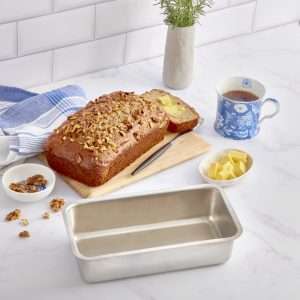
Stainless steel bakeware often gets grouped into one category... it all looks the same, right?! In reality, the quality and composition can vary quite a lot.
It’s a bit like shopping for cotton sheets. They might all be labelled “100% cotton”, but anyone who’s compared budget sheets with hotel-quality linen will be able to tell you the difference. Thread count is often thrown around as a measure of quality, but even that doesn’t tell the whole picture. The type of cotton, the weave and how the sheets are made all play a part.
Stainless steel is the same. Two baking trays can both be labelled “stainless steel”, yet perform very differently over years of everyday use. That’s not because one is automatically “good” and the other is “bad”. They’re just made differently and designed with different priorities in mind.
Once you understand that, the differences in performance, durability and price start to make much more sense.
Myth #1: Stainless steel is all the same
One of the biggest misconceptions is that stainless steel is a single material, when it’s actually a whole family of metal alloys. There are hundreds of different types of stainless steel, each developed for different applications.
Some are designed to withstand salty marine environments. Others are commonly used in commercial kitchens. Some are made without nickel. Others are chosen because they’re particularly strong or cost-effective. That’s why asking whether something is made from “stainless steel” doesn’t tell you very much.
Small differences in composition, thickness and manufacturing can all influence how a product performs over years of heating, cooling and everyday use.
Myth #2: The biggest number is always the best
Once people discover terms like 18/0, 18/8, 304 or 430 stainless steel, it’s easy to assume there’s a simple ranking system where bigger numbers mean better quality. It’s a little like thread count in cotton sheets. Just as a higher thread count doesn’t automatically make one set of sheets better than another, a stainless steel grade doesn’t tell you everything about how a product will perform.
304 and 430 are just two examples within a much larger family of stainless steel alloys. There are actually over 150 different grades of stainless steel, which are often grouped into four or five major categories: austenitic, ferritic, martensitic, duplex and precipitation-hardening.
Different grades exist because they’re designed to do different jobs. Each has its own strengths, and manufacturers choose them based on how they want a product to perform. The same is true throughout your home. Your kitchen sink, cutlery, saucepan and baking tray may all be made from stainless steel, but they aren’t necessarily made from exactly the same alloy.
|
|
|
|


Myth #3: If a magnet sticks, it’s poor quality
This is probably one of the biggest myths we come across. Many people believe that if a magnet sticks to stainless steel, it must be lower quality. Others believe the opposite. The truth is, magnetism alone doesn’t tell you whether a product is “good” or “bad”.
Some excellent stainless steel grades are magnetic. Others aren’t. Whether a magnet sticks depends on the structure of the particular alloy, not whether it’s suitable for your kitchen. It’s a fun test to try at home, but it’s not a reliable way to judge quality.
So why do similar trays cost different amounts?
If two baking trays look almost identical, why can one cost considerably more than the other? The answer usually comes down to a combination of factors: the type of stainless steel selected, the thickness of the material, manufacturing methods, finishing and quality control (including independent testing), and the intended lifespan of the product.
Designing bakeware that's food-safe, corrosion-resistant, durable and reliable over years of everyday use means quality standards need to be high. Stainless steel isn't an easy metal to bend or shape, so special considerations go into every design choice.
For bakeware you'll use every week for years, it's worth considering the grade of stainless steel and the reputation of the brand behind it, not just the price tag.
Why we use both 304 and 430 stainless steel
One of the best examples of why there isn’t one “perfect” stainless steel is our own product range. Rather than using the same grade across every product, we choose the material that best suits what each product is designed to do.
Much of our bakeware is made from 304 stainless steel because it offers excellent corrosion resistance and long-term durability, making it a great choice for products designed to spend years in the oven.
For products like our muffin pans and other specialised moulds, we use 430 stainless steel. As a nickel-free grade, it’s particularly well suited to creating more intricate shapes while still delivering the performance we’re looking for.
Neither choice is about one grade being “better” than another. It’s about selecting the right material for the job. Just as you wouldn’t expect every tool in a toolbox to be made the same way, different types of bakeware can benefit from different types of stainless steel.
Just like cotton sheets, the real difference shows up over time
The biggest differences between stainless steel products rarely appear straight out of the box. They become more noticeable after hundreds of bakes, countless dishwasher cycles and years of regular use.
As with cotton sheets, it's not always obvious on day one. It’s only after months of washing, sleeping and living with them that you begin to notice the difference in comfort, quality and longevity.
What should you actually look for?
Rather than focusing on a single number, consider asking:
- Does the brand clearly explain which stainless steel they’ve chosen?
- Have they done any independent testing?
- Is the bakeware designed for regular, long-term use?
- Are they transparent about the product’s characteristics, rather than promising perfection?
- Do they offer education and advice on how to care for your products?
The answers to those questions will usually tell you far more than any magnet test ever will.
The important thing isn’t the number. It’s asking better questions.
At The Low Tox Project, we spend a lot of time asking questions most people don’t think to ask. Why was this material chosen? How will it perform after five years, not five uses? What’s the trade-off? Is there a better way?
Sometimes the answers surprise us. Sometimes they change the products we create. If you’ve made it this far, chances are you’re just as curious as we are.
Have a look around our range and see what thoughtful design looks like in practice.