If you’ve seen headlines about PFAS being banned in Australia, you’ve probably wondered what that means for the products already sitting in your kitchen. From 1 July 2025, Australia introduced new restrictions on several PFAS chemicals. Since then, regulators have continued to look more broadly at the use of PFAS in Australia.
Non-stick cookware often gets pulled into the conversation, so we thought it was worth looking at what’s changed, what hasn’t, and what it might mean when you’re choosing cookware: no panic, no clearing out the kitchen cupboards, just the facts.
First, what are PFAS?
PFAS stands for per- and poly-fluoroalkyl substances. It’s the name given to a large group of manufactured chemicals that have been used in a wide range of products and industrial applications since the 1950s.
Their properties can make them useful where resistance to heat, grease, stains or water is needed. According to the Australian Government, PFAS have been used in products and applications including some food packaging, stain protection, firefighting foams and the manufacture of some non-stick cookware.
You may also have heard PFAS referred to as “forever chemicals”, a term commonly used because some PFAS are highly persistent and can remain in the environment for a long time. But there’s an important distinction here: PFAS isn’t one single chemical. There are many different PFAS, and some receive far more regulatory attention than others.
So, has Australia banned PFAS?
Not quite. From 1 July 2025, Australia introduced new national controls that ban or severely restrict three PFAS groups: PFOS, PFOA and PFHxS, including certain related substances. The restrictions form part of Australia’s Industrial Chemicals Environmental Management Standard, known as IChEMS.
So while you might see this referred to more broadly as “the PFAS ban”, it doesn’t mean that every chemical classified as a PFAS suddenly became prohibited in Australia. And the story hasn’t stopped there. In October 2025, the Australian Industrial Chemicals Introduction Scheme (AICIS) began an evaluation covering 522 PFAS chemicals listed on the Australian Inventory of Industrial Chemicals.
The evaluation is assessing whether those chemicals are being introduced or used in Australia, what they’re used for, and in what volumes, to help determine whether further evaluation is needed. Further PFAS chemicals were also added to the IChEMS Register in June 2026.
So, in other words, PFAS regulation in Australia is changing frequently, and it's best to consult the latest government broadcast for the most up-to-date information.
What does this have to do with cookware?
This is where things get relevant in the kitchen. PFAS have been used to manufacture some non-stick cookware, which is why cookware often comes up in discussions about these chemicals. It’s also where the terminology can get confusing very quickly.
PFAS, PFOA and PTFE don’t all mean the same thing.
PFAS refers to a broad family of chemicals. PFOA is one particular PFAS that is now subject to restrictions in Australia. PTFE, meanwhile, is a fluoropolymer widely used to create non-stick surfaces.
So a claim such as “PFOA-free” shouldn’t automatically be interpreted as meaning the same thing as “PFAS-free”. That's important when you’re comparing cookware and reading product claims.
Does this mean you need to replace your non-stick cookware?
Yes, and no. We don’t think a changing regulation needs to trigger a kitchen clean-out. If you’ve been around The Low Tox Project for a while, you’ll know our approach is generally to make considered changes rather than feeling like everything needs to be replaced overnight.
But the science and guidance are there to help us make the most informed decisions. If you’re concerned about your cookware, look at the information provided by its manufacturer. Find out what the cooking surface is made from, what coatings have been used and exactly what any “free from” claims refer to. And when cookware starts to flake or peel, or just isn’t performing well anymore, that's an opportunity to decide what materials you want to bring into your home next. And it's why we always choose simple, uncoated stainless steel.
To learn more about coatings, the Hollywood film Dark Waters spotlights Teflon and coated cookware, and it's definitely worth a watch! There are also multiple documentaries on reducing plastic in your home.
Why we chose stainless steel
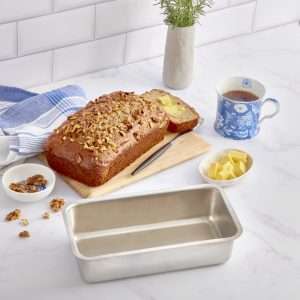
One reason we chose stainless steel for our cookware and bakeware is that it keeps the cooking surface simple. Our stainless steel bakeware and cookware are uncoated. We don’t apply a non-stick coating to the cooking surface to create non-stick properties.
Of course, that also means stainless steel behaves differently from coated non-stick cookware. A common thought is that food will stick to stainless steel, but it's actually not as tricky as non-stick infomercials will have you believe. Depending on what you’re making, you might just need to preheat your pan, use a little oil or grease, line your bakeware, or let baked goods cool before removing them.
There can be a small learning curve, but once you know how to work with stainless steel, it’s a wonderfully versatile material that’s designed to be used again and again.
 |
 |
 |
What should you look for when buying cookware?
You don’t need to become a chemist to buy a baking tray or frying pan. A few straightforward questions can tell you a lot:
- What material is the cooking surface made from?
- Is it coated or uncoated?
- If there is a coating, what is it made from?
- If the product makes a claim such as “PFOA-free” or “PFAS-free”, what exactly does that claim cover?
- Does the manufacturer provide useful information about the materials and construction of the product?
It’s also worth thinking beyond the latest headline. How will you use this cookware? How long is it likely to last in your home? Can it handle the way you cook? And are you comfortable with what it’s made from? Those questions are usually much more useful than trying to “fix” everything in your kitchen immediately. If an uncoated cooking surface is important to you, stainless steel is one option worth considering.
Take a look at our stainless steel range today.
FAQs on PFAS
Are PFAS banned in Australia?
Some are. Australia introduced bans or severe restrictions on PFOS, PFOA and PFHxS from 1 July 2025, subject to the requirements and exemptions set out under IChEMS. Other PFAS continue to be assessed and regulated separately.
Are PFAS used in non-stick cookware?
PFAS have been used in the manufacture of some non-stick cookware. However, different products and coatings can have different chemical compositions, so it’s worth checking information provided by the individual manufacturer rather than assuming all cookware is the same.
Does PFOA-free mean PFAS-free?
No. PFOA is one substance within the much broader PFAS group, so a “PFOA-free” claim by itself doesn’t mean a product is free from all PFAS.
Does stainless steel cookware have a non-stick coating?
Not necessarily. Stainless steel refers to the underlying material, so coatings depend on the individual product. The Low Tox Project’s stainless steel cookware and bakeware have an uncoated stainless steel cooking surface.
Should I throw out my existing non-stick cookware?
The introduction of the new PFAS restrictions doesn’t mean you need to immediately dispose of cookware you already own. In fact, IChEMS guidance says its standards generally don’t restrict or ban articles already on the market when a new standard begins. If you’re unsure about a particular product, check its materials and coating with the manufacturer and make your next replacement based on the information available.