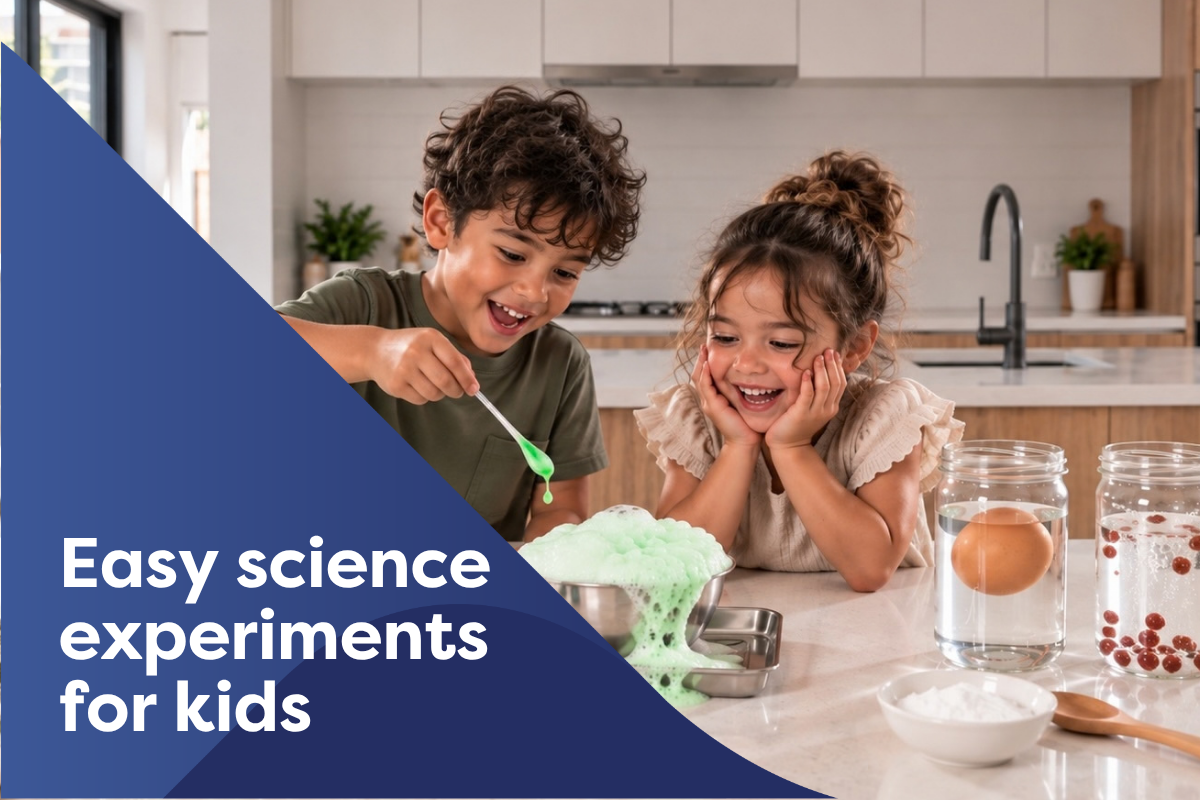
You don’t need a fancy science kit to do a science experiment! Your kitchen is already full of things that fizz, float, change colour and behave in surprisingly weird ways. And some of the best experiments are the simplest ones. The kind that use a few things you already have in the cupboard, take five minutes to set up and somehow keep the kids entertained for far longer than you expected. We’ve tried plenty with our own kids over the years, so we’ve pulled together five of our favourites to share with you.
Whether you’re looking for a school holiday activity, something to fill a rainy afternoon, or you just have a curious kid asking “but why?” for the 47th time today, these easy kitchen experiments are a fun way to get them predicting, testing and figuring out what’s actually going on. There might even be a little science lesson in there somewhere. Just don’t tell them that.
Before you start: These experiments are designed to be done with adult supervision. Keep ingredients out of little mouths and eyes, wash hands afterwards and use age-appropriate containers and utensils.
1. Dancing sultanas
Naturally, when your founder’s surname is Sultana, there was really only one place we could start. This ridiculously easy experiment uses the bubbles in sparkling water to make sultanas bob up and down in the glass. Or, as we prefer to call it, dance.
You’ll need
- A clear glass
- Sparkling water
- A few sultanas
What to do
Fill your glass with sparkling water and drop in a few sultanas... then watch what happens. You should start to see bubbles gathering on the wrinkly surface of the sultanas. Before long, some will begin rising towards the top of the glass, sinking back down and rising again.
What’s happening?Sparkling water contains carbon dioxide gas, which creates all those tiny bubbles. The bubbles attach to the surface of the sultanas and give them enough buoyancy to rise through the water. When they reach the surface, some of the bubbles pop or escape. Without their bubbly little life jackets, the sultanas sink again. Then more bubbles attach and the dance starts all over again. A test to try: Do different sized sultanas behave differently? What about raisins or grapes? Make a prediction before you drop them in. |
 |
2. Magic milk
This might be the prettiest kitchen science experiment on the list! A few drops of colour, one tiny drop of dishwashing liquid and suddenly everything starts moving.
You’ll need
- A shallow bowl
- Milk
- Food colouring
- Dishwashing liquid
- A cotton bud
A note on colours: plenty of our community skip synthetic food dyes, and that's fine here too. Try natural food colouring, or make your own with beetroot juice for pink, turmeric for yellow or red cabbage water for purple. The colours might be a little softer, but the science works the same.
What to do
Pour enough milk into the dish to cover the bottom. Add a few drops of different food colours around the surface. Try not to stir them together. Dip the end of a cotton bud into dishwashing liquid, then gently touch it to the surface of the milk. Watch what happens to the colours.
What’s happening?Milk contains water, proteins and fats. Dishwashing liquid molecules interact with the fat and also disrupt the surface tension of the milk. As the detergent spreads and interacts with the milk, it creates movement in the liquid, carrying the food colouring along with it and creating those swirling patterns. A test to try: Does it make a difference if you use different types of milk? Make your predictions first. |
 |
3. Walking water
Can water move from one glass to another without you pouring it? Turns out... yes!
You’ll need
- 3 clear glasses
- Water
- Food colouring (optional)
- Paper towel
A note on colours: plenty of our community skip synthetic food dyes, and that's fine here too. Try natural food colouring, or make your own with beetroot juice for pink, turmeric for yellow or red cabbage water for purple. The colours might be a little softer, but the science works the same.
What to do
Place the three glasses next to each other. Add water to the first and third glasses, leaving the middle one empty. Add food colouring to each glass of water (first and third). If you use different colours, you’ll have more of an effect at the end as they mix.
Fold two pieces of paper towel lengthways into strips. Put one end of the first strip into glass number one, and the other end into the empty middle glass. Do the same thing with the middle glass and glass number three.
Now… leave them alone and check back regularly. You should gradually see the coloured water travel up the paper towel and into the middle glass. This one can take a little patience (and over 24hrs), so leave the glasses somewhere safe and come back to see what’s changed.
What’s happening?This is called capillary action. Water can move through tiny spaces in the fibres of the paper towel. The attraction between the water and those fibres helps pull the water upwards, while cohesion between the molecules helps other water molecules follow along. Eventually, gravity helps draw the water down into the empty glass. A test to try: Use two different food colourings. Ask the kids what colour they think will appear in the middle before the two colours meet. |
 |
4. The floating egg
If you drop an egg into a glass of plain water, a fresh egg will usually sink. But can you change the water enough to make it float?
A quick note before you start: You might already know that floating an egg in plain water is sometimes used as a freshness test. Older eggs become more buoyant as the air cell inside them gets larger. For this experiment, start with a fresh egg that sinks in plain water. We’re going to make it float for a completely different reason.
You’ll need
- A clear glass or container
- Water
- Salt
- An egg
- A spoon
What to do
Fill the glass with water and carefully lower the egg in. It should sink. Take the egg back out and start adding salt to the water, one teaspoon at a time, stirring until it dissolves. After each teaspoon, check if your egg starts to float. Repeat the process until your water is salty enough and your egg is floating.
What’s happening?This science experiment for kids is all about density. A fresh egg is denser than plain water so it sinks. Dissolving salt in the water increases the water’s density. Once the saltwater becomes dense enough, it can provide enough buoyant force to support the egg, and it rises up. A test to try: Before you begin, guess how many teaspoons of salt you’ll need to make the egg float. Were you close? |
 |
5. Make a bicarb soda volcano
It’s a classic for a reason. A little bicarb soda, a splash of vinegar and suddenly you have an erupting volcano on your kitchen bench. This one can get messy, so we recommend putting your volcano in the sink, on a tray or taking the experiment outside.
You’ll need
- A shallow bowl or cup
- Bicarb soda
- Vinegar
- A tray (unless you’re doing it in the sink or outside)
- Food colouring (optional)
What to do
Place your container in the middle of a tray or sink. Add a few spoonfuls of bicarb soda to the container. If you want a colourful eruption, add a couple of drops of food colouring too. Now pour in a little vinegar and watch your volcano erupt.
What’s happening?When vinegar and bicarb soda meet, an acid-base reaction takes place. Vinegar contains acetic acid and bicarb soda is a base. When they react, one of the things produced is carbon dioxide gas. That gas creates all those rapidly expanding bubbles, which push the mixture up and over the sides of the container to create your eruption. And if carbon dioxide sounds familiar, there’s a reason. It’s the same gas responsible for the bubbles that carried our dancing sultanas up through the sparkling water in experiment number one. Bonus idea: red cabbage water turns pink when it meets vinegar. If you use it in the volcano, you get a natural colour change as well as an eruption. |
 |
Your kitchen is basically a science lab
Once you start looking for it, there’s science happening all over the kitchen. Bread dough rises, chocolate melts, eggs change when you cook them, water boils, food browns. And yes, apparently sultanas can dance.
Cooking and baking give kids a chance to see things like chemistry, physics and biology happening right in front of them, without needing to call it a science lesson. So the next time you hear “I’m booooored”, grab a few things from the kitchen and see what happens. Just maybe keep a cloth nearby. In our experience, science can get messy!
Ready to make a little mess?
From bowls to trays, our stainless steel kitchen range is made for baking, cooking, experimenting and all the other things family kitchens get up to.